Monday, 9 January 2012

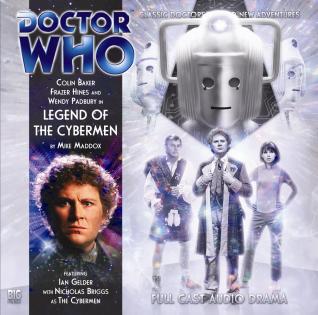
Legend of the Cybermen written by Mike Maddox and directed by Nicholas Briggs

What’s it about: The Cybermen are on the march through the Hundred Realms, killing and converting as they go. Resistance is useless. Trapped on the outermost fringes of the battle, the Doctor and Jamie are astonished to encounter an old friend: astrophysicist Zoe Heriot. It's the happiest of reunions. But what hope is there of a happy ending against the unstoppable Cybermen?

Softer Six: He keeps forgetting that Jamie and he have technically just met and the Highlander doesn’t understand what he means when he says run… He’s not a what he’s a Who! He is a Time Lord and he doesn’t need to be lectured on temporal solecisms by some penny dreadful pedant! Zoe asks the Doctor how he came to look so different and the Doctor begins his explanation by saying it all happened the day they last saw him – if he’s going to tell the entire story of Doctor Who from 1969 through to 1985 I think there should be the audio equivalent of asterisks to show that some time has past! Or better still you can use this as a Wheel in Space style thought scanner excuse to watch all the stories between The War Games and The Twin Dilemma! Getting into the fictional spirit the Doctor says his life is an open book of the Prydonian Chapter. Because he is usually so charming it is easy to forget how one track minded the Doctor can be and he develops an instant dislike of Dracula based on no more than the words that Bram Stoker wrote. There is a history between the Time Lords and Vampires – bad blood you might say but you would think he might be able to put all that aside for what is essentially a fictional creation! Jamie calls the Doctor on how they got the original Master of the Land of Fiction home and he cannot give a satisfactory answer – I’m really glad they didn’t explain that because its ambiguity was what made that story such a fascinating tale. I cannot believe the story tries to sell that the Doctor, Jamie and Zoe had never escaped the Land of Fiction and that everything since has been a dream. Its such an alarming, absurd idea that had they tried to suggest it was real I wouldn’t have known what to think but as it is it is a one minute moment of glorious madness before an even bigger twist crowbars its way in. The Doctor admits that he is no longer running away from the Time Lords, these days it is borderm mostly. Jamie asks what Sarah asked in School Reunion and Jo asked in Death of the Doctor…why did the Doctor not return for him and Zoe? Jamie wonders if the Doctor moves on and forgets about those who have travelled with him but he denies that vehemently. He tries to say sorry but words aren’t appropriate for how the real Jamie McCrimmon was violated.

Who’s the Yahoos: The Doctor tells Jamie that this world is made out of the imagination but not their imaginations but that doesn’t stop Jamie trying to conjure up a bottle of whiskey and a lassie with a cheeky smile! Zoe tries to unlock his memories by given him a data retrieval node but he initially refuses saying that he has read the bible and knows all about young men being tempted by lassies with apples. This whole trilogy has been leading up to the point where Jamie gets his memories back and learns about his previous life with the Doctor and the sequence doesn’t disappoint. The listener is assaulted with a barrage of spine tingling sounds effects from Jamie’s adventures in the TARDIS – Quarks, White Robots firing, the Yeti activation noise… It’s a nostalgia fest! He remembers the horrors but also that he had good friends…Sailor Ben, bean poll Polly, Victoria who was precious like china and Zoe, the clever one. The Doctor was small and scruffy with a funny little gleam in his eye. Its only been a month for Zoe but he has lived a full and fruitful life since they last saw each other and it has been a good life. Making Jamie a fictional character was probably not an result that any of us wanted but its still a hell of a shock. All of a sudden you have to question everything that has happened since this trilogy began and of course Jamie first met the Doctor in Scotland which was part of the Land of Fiction so it all makes perfect sense. But I so wanted them to go off travelling together again at the end. Still even a fictional Jamie is still a great character and he has developed a fine chemistry with the Doctor in this run of stories and it has been great to catch up with Frazer Hines again who gives his all whether the character is real or not. Jamie is violently angry about this revelation because he is finding it hard to accept so many different version of his life – firstly his life with the Doctor and then the fact that he isn’t real. It is rather a lot to take in to be fair. Zoe created this version of Jamie and took away his memories so the Doctor had a mystery to solve so he would stick with him. All those pieces are coming together nicely. The Doctor offers him the post as the Laird of the Land of Fiction but Jamie knows that all he is good for is fighting. They embrace warmly and even though he knows he isn’t the Jamie he knew there is still a connection there.

Brainy Beauty: I got crazy excited when Zoe turned up to save Jamie – listening to this pair together again, one of my personal favourites of the classic series, is an absolute joy. I loved the reference that Jamie has gotten old when its clear that Wendy Padbury’s voice has…matured too. She’s appalled that Jamie thinks he has conjured her up out of his imagination and she certainly doesn’t have any Whiskey secreted about her person thank you very much! Zoe confuses the Doctor for the Artful Dodger and gives him a massive hug. The second big twist is the unshrouding of the Mistress – its Zoe, our Zoe and the one we have been travelling with is an avatar. She has been trying to hold the Cybermen off with stories from her childhood and waiting for the Doctor to find her. It was years later on the Wheel and Zoe was remembering how they had fought the Cybermen together and she went for a medical scan and learnt that she was a two years older than she was a few days ago. She worked it out for herself that she had travelled with the Doctor and had her memories wiped. The Cybermen captured her and decided she would make a good Cyberplanner and when they probed her mind something snapped the mental blocks the Time Lords imposed fell away. With her super brain Zoe conquered the Cybercomputer and brought them somewhere she knew they could do no harm – the Land of Fiction. She plugged her subconscious into the Master Brain and she has been fighting the Cybermen ever since. She gave the characters freewill, made them cunning and unpredictable. The Doctor knows that as soon as she leaves The Land of Fiction Zoe’s memories will shut down again and he lays her back on the Wheel.

Standout Performance: It’s the sort of story where you have to commend actors for throwing themselves wholeheartedly into something truly out of the ordinary and there is no better example than Ian Gelder’s superb Count Dracula. As well as making the speeches about his backstory sound like poetry he also manages to play the part with a great deal of pathos and by the end you are cheering his character on. Listen the way he says Cybermen – its delicious. His conversion is a tragic end for his character but his strength of will invades the Cyberplanners consciousness.

Sparkling Dialogue: ‘How did you do that?’ ‘Magic, obviously.’
‘I’m sure its much easier to send your troops to their deaths when they look like toys!’
‘You’re standing in an enchanted forest looking through a magic window made of fairy dust and you’re telling me something’s odd!’
‘Remember when Grendel’s mother attacked the Cyber Controller…?’
‘None of this is real. It’s all a wonderful children’s adventure which adults adore.’
‘The Cybermen have converted mermaids!’ ‘Oh, that’s just wrong’ – thanks for saying it for me!
‘I think you’ve complicated your plot quite enough!’
‘You’ll never beat McCrimmon yet,
Jamie bellowed at the silver threat,
And once more with battle met,
And vigour undefeated his muscles stretched, his sinews keen,
He slew the half man-half machine!’
‘And I was lost to her again…’

Great Ideas: The White Robots are look a bit more sophisticated since the Doctor last met them and he suspects that the Master of the Land of Fiction has been upgraded too. Odd that because they are exactly the same as The Mind Robber on the inside sleeve! There are some kisses to The Mind Robber as you would expect such scenes of the Doctor and Jamie wandering around the void, lost, and screaming out each others names. It’s a chance for the writer to enjoy bringing to life some of the best fictional characters ever written and the first one the Doctor stumbles across is the Artful Dodger! The Doctor has read Oliver Twist half a dozen times but he doesn’t recall the Dodger saying ‘We may be following a by and large linear narrative but out here continuity is distinctly malleable!’ There’s a magic forest where the fairies live which they use a safe hiding place where you can find the land of Camelot. How awesome is it that the Cyberplanner is located at Dracula’s castle? Every time we cut back to him there is a gothic organ playing and lightning striking like he is some mad scientist plotting for the Cybermen! Apparently Sherlock Holmes was a General but he had his own demons to face. The Cybermen don’t want control of the Land of Fiction, they want the power of the Master Brain which can adjust the thoughts of all mankind and make them like them. At first I wondered how on Earth Mike Maddox was going to pull off such an insane concept as the Cybermen in this imaginative realm but that is actually a rock sold motive to back up all this madness. Bravo! They seek to destroy the human imagination because once that is destroyed humanity itself is destroyed. They would be robbing humanity of the ability to tell stories, to lie or even to exaggerate. The Cybermen had the fortune to convert werewolves…what a horrifying idea! This opened their minds to new kinds of Cyber conversion and they started with the fairies. Oh this is great stuff, absolutely barking.The catacombs have been turned into refinery to extract the blood of the land, ink. Just like the factories in the Scottish landscape and the hold of the Nautilus. The ink is being collected and used the way it would be on the page, to create more fictional characters – bloody genius! Cheekily the Doctor hums Ride of the Valkeries as spirit maidens but the Cybermen have converted their wings and turned them into jet engines. Giant behemoth Cybermen stomp forward to attack. Characters in the Land of Fiction literally bleed blood. It couldn’t have been long before the great white whale Moby Dick reared its head except it has been fitted with portholes and torpedo tubes by the Cybermen! The Nautilus makes a spectacular return with Nemo and Rob Roy on board tying the three stories together even tighter. Zoe describes the Doctor’s adventure to her as ‘psuedo historical to base under siege!’ Cyber fairies attack! The space leeches from City of Spires were the Karkus’ enemies from the Hourly Telepress brought to life. Zoe tried to bring the Doctor to life fictionally by novelising all of their adventures together and she shows the real Doctor her library featuring Doctor Who and the Dominators and Doctor Who and the Krotons. If this story parodies anything else I know to be true I’m going to start wondering if I am real. I love how Jamie and Rob Roy vanquishing the Cybermen is narrated in the form of a good old fashioned Scottish poem and joyfully reality shifts halfway through a stanza and Jamie is left without a rhyme to finish! All the fictional Cybermen are made to disappear when Dracula convinces the Cyberplanner that they never existed in the first place. With the stain of the Cybermen wiped from its pages the Land of Fiction began to grow again becoming something quite different – a wonderland with Alice as its mistress.

Audio Landscape: Prepare yourselves for the audio experience of a lifetime as Nicholas Briggs and Jamie Robertson take you on a surreal adventure through The Land of Fiction! The mechanical grinding of the White Robots, that fantastic alien hum of the void, clockwork ticking, squeaky door, Jamie falling a great height lured on by Zoe’s voice, dripping tap, mechanical Cyber footsteps, the White Robot firing noise, thunder rumbling, the bubbling voice of the Cyber planner, birdsong, fairies tinkling around Jamie, dog barking, unicorn whinnying, trees swaying, bubbling ink making a person, siren, Dracula vanishing in a puff of smoke, bombing raids, spitting, crackling flames, Zoe trapped under rubble, bomb whistling to the ground, explosions, flintlock going off, a spindle radio dish, wolves baying in the distance, running water, crossing a rope bridge, a Cyberman falling down a chasm, ooh an old fashioned internet connection noise, storybook noise, biting wind, knocking on a glass booth, a sea shanty, Karkus teleportation noise, the gigglingly childish Cyber fairies, Cyber mermaids squeaking on the hull of the Nautilus.

Musical Cues: The clockwork soldiers are accompanied by a jaunty marching band tune this time around, a handy audio sign that they are close by. Once all the cards are on the table we are treated to some fantastic music in the second episode – exciting beats when the Cybermen attack, a rousingly heroic theme in Camelot and a dashing fun as Jamie heads on a horse!

Standout Scene: Only Doctor Who could get away with something as utterly bizarre and chilling as the end of episode one. Putting aside the fact that we are walking around in a world where fictional characters can come to life there is the additional threat of the Cybermen who are revealed here as Oliver Twist steps from the mist half converted asking in an electronic buzz ‘please sir, I want some more…’ Its funny, macabre and shocking. I love it.

The story takes a wonderful diversion into bedtime storytelling as each of the characters narrates a little piece of the action in a unique way. Dracula reads the spine chilling words of Bram Stoker’s classic, intersped with scenes of magic fantasy read by Alice – the two stories colliding with the young girl almost murdered when the white rabbit (the Doctor) pops up to tell them both that the Cybermen are playing with their perception of reality! Zoe reads The Secret Fairies, asking if you have a responsible adult to make you a nice glass of synthymilk and giving you the special noise to indicate when to turn the page. Jamie winds up in a audio recording booth at Big Finish Productions with director Nick Briggs giving him instructions on how to proceed with his reading. The Doctor starts talking from the very next booth and prevents Jamie from being taken over by Briggs/the Cyberman! All of this goes somewhere beyond epistemological post modernism and meta fiction into a spiralling descent of unreality but I love it. Its such an imaginative and clever way to tell the story, I was grinning gleefully throughout.

Result: Prepare yourself for the greatest mindfuck fan fiction experience of the century! Every time I thought Legend of the Cybermen couldn’t throw anything more insane at me it always managed to find some other little creative titbit in the darkest recesses of its twisted imagination. Where else will you find Dracula telling to Little Lord Fauntleroy to try and hold Atlantis back from Cyberman invasion? We’ve got gothic Cyberplanners, Moby Dick with torpedo tubes, bedtime storytelling, fictional characters bleeding ink, Cyber converted fairies, and even Nick Briggs making a cameo as himself! Underneath all the creative bluster there is a touching character tale taking place dealing with the aftermath of The War Games and the tragic circumstances surrounding Jamie and Zoe’s departure. We learn that Jamie isn’t real but that isn’t enough, Zoe is revealed as the Mistress of the Land of Fiction and that isn’t enough, characters from the first two stories of the trilogy join the fight and that still isn’t enough…this is a story that keeps giving, twisting, evolving, subverting until I was left tied up in fictional knots and laughing manically all the way. For the chance to hear Colin Baker, Frazer Hines and Wendy Padbury working together it is a treasurable on its own but Legend of the Cybermen also features a cinematic array of audio landscapes, moments that will make you laugh and cry at the same time and a stirring musical score. Its everything this climatic final instalment needed to be and it answers the stack of mysteries very satisfactorily and has a tearjerking final scene. Its completely, mind bogglingly, escaped from an asylum madness and I loved every second of it: 10/10

Sunday, 8 January 2012

The Wreck of the Titan written and directed by Barnaby Edwards

What’s it about: 'It's the biggest ship the world has known – and in just twenty minutes' time it's going to hit an iceberg the size of Ben Nevis!' The North Atlantic is a treacherous place at the best of times. 14 April 1912 is the very worst of times. The Doctor and Jamie find themselves trapped aboard the RMS Titanic, 400 miles off Newfoundland and heading towards a conclusive appointment with destiny. But the iceberg isn't their only problem. Down in the inky depths, something is hunting: something huge, hostile and hungry. This should certainly be A Night To Remember

Softer Six: How sweet that when the Doctor takes Jamie for what appears to be his first proper trip in the TARDIS he wants to make an event out of it and blindfolds him. The Doctor declares that in this time America is quite civilised (and then I’m sure he thinks of Peri when he says ‘for the most part…’). He’s quick to realise that this Titanic is a fake and is quite acidic about assigning the blame. I love how much fastidious detail he can conjour up to blow the charade, he is clearly and extremely well read Time Lord. When his theme park ride theory goes out the window the Doctor admits he is out of ideas. Its rare to hear him say that and even rarer for the sixth Doctor to admit it! The Doctor is convinced that Jamie is resourceful enough to escape the sinking of the Titan but comes to realise that he must be dead. Its uncomfortable to see the sixth Doctor so distraught as he quietly admits that this was supposed to be a treat for him. His admittance that he wanted it to be like the good old days is heartbreaking and in a moment that mixes grief and beauty to profound effect he quotes Hie Away by Sir Walter Scott for his dead friend. Things look bleak as he is hunted by polar bears but the Doctor insists that where there is beauty (the stunning ice landscape) there is hope. His dialogue really is superb in this adventure; he thinks there is no point in being a homo sapient if you aren’t going to exercise the sapient bit! When facing two hungry polar bears the Doctor tries to confuse them with a blood soaked hanky and a jacket. There’s another touching reunion between the Doctor and Jamie where he laughs heartily at the sight of his friend – there is real dramatic mileage in this pairing and it’s a shame it will be over with in the next story. The Doctor claims that TARDIS is impervious to attack by giant squid and says he came close to proving it on one of the moons of Delta Magna. He starts reading some rather florid prose but has to stop before his stomach turned (‘When was this banausic drivel published?’).

Who’s the Yahoos: Jamie wont believe that the TARDIS can travel through time and space until he can see it with his own eyes. With no pretty wee lassie in the TARDIS for Jamie to protect it doesn’t take him five minutes to team up with the prettiest girl around. His Jamieisms are getting better – he mistakes a metaphor for a metal floor and calls the Nautilus a naughty lass! He’s clearly been taking notes from the Doctor in the circumstance of weak women refusing to push themselves hard enough to survive because he goads Myra saying she is a pathetic young girl in order to give her the anger and strength to survive the sinking ship. ‘Oh my goodness! A big sea beastie!’ he cries when he sees the Nautilus.

Standout Performance: I didn’t realise that Tess was being played by Miranda Raison until she transformed into Myra and adopted the same American accent as she used for Tallulah in Daleks in Manhattan! Fortunately I loved her in that story and she is similarly charming and funny in this. Its probably the only instance where I have enjoyed a fake accent more than a real one! I’m a massive fan of Star Trek Deep Space Nine so when I heard that Alexander Siddig was going to take part in this story it only whetted my appetite further. He's quietly menacing and I'm glad we get to hear more of him in the next story.

Sparkling Dialogue: ‘Jamie this is the Titanic. Forty six thousand tons of steel, wood and glass, nine storeys of art noveau splendour, nearly nine hundred feet long and ninety feet wide with a capacity for three and a half thousand passengers and crew! It’s the biggest ship the world has ever known and in just twenty minutes time its going to hit an iceberg the size of Ben Nevis and sink!’ – Colin Baker’s sixth Doctor is made for rousingly descriptive speeches like that.
‘I don’t know how Father Christmas manages it!’ says the Doctor as he shoves derriere up and out of an ice chimney!
‘This is rapidly turning into an episode of The Waltons!’

Great Ideas: The Doctor thinks he has landed on the Queen Mary in May 1946 (indeed he is delighted to inform Jamie of the fact) but his companion can see with his own eyes that it is April 1912 and they are on the Titanic. I’ve always fancied a Doctor Who version of the Titanic tale and this is the closest we are ever going to get. The Doctor thinks this must be some kind of tragedy tourists style of entertainment, re-enactments of famous disasters for paying customers to witness. The first episode works a treat because everything is a little bit askew – you aren’t sure what is going on, who is who or even where the Doctor and Jamie have arrived. Nothing is fixed and that is quite an exciting feeling to have. Barnaby Edwards cleverly shifts the cliffhanger to the first episode from the point of view of a completely different character at the beginning of the second – its so seamlessly done you might not even notice it but it is gorgeous little touch. The Doctor’s next big guess is that they are stuck in a time fissure where time divides into two distinct paths – that would explain the existence of the two ships and their similar fates. You’ve got to give the man a round of applause for trying to give this a plausible explanation – the real one is just out of his grasp and back in his long history. The beginning of episode three sees another neat narrative trick, popping back in time to show how we reach the end of episode two from Jamie’s point of view. That’s really neat. I would love to be able to look out of the observation bubble of the Nautilus and see the underwater world lit up in all its marine glory. The Doctor’s third attempt at a guess is that they are in some kind of mad computer game! Credit for persistent theories, Doc! But then considering the wealth of insane genres he has tiptoed through in his adventures anything is possible!

Audio Landscape: We open with a trumpeting horn from a ship and a stirring score – a sure sign that this is going to be one of the most immersive Big Finish productions. Squeaky doors, the swaying ocean, the party atmosphere aboard the ship, polite clapping, screaming. The ship undergoing a metamorphosis sounds like panel breaking free, wood snapping, glass breaking…absolute chaos. Did they literally cause an iceberg to hit a ship because it sounds absolutely authentic – you can hear the hull of the ship scraping along the ice, windows smashing and huge chunks of ice breaking free and the mast hitting the deck. The ship groans terribly as it turns on its side, Jamie and Myra sliding down the deck, the portholes blowing up, the engine room exploding, the echoing emptiness of the hold, the freezing wind screaming, screaming polar bears, snowy footsteps, an echoing ice chimney. There’s a glorious moment that works so well on audio where John realises that there are two sets of footprints and they stop talking to hear the padding of polar bear footprints very close to them. The bears can be heard growling in your ears as their padded feet run at the travellers. A submarine breaks the water sounding its fog horn and you can hear the ship grinding under the water, causing showers of bubbles. Sonar, wading through water, a champagne cork popping from a bottle, water trickling from the ceiling, banging morse code, sparks spitting from metal as the wall is cut down, bubbling test tubes in the laboratory. You hear the Professor’s escape craft being crushed by the giant squid as he has made off with the ink. Pages flapping in the wind lead to the reveal of where the Doctor has always been. The final terrifying sound is the grinding of the White Robots coming out of the mist!

Musical Cues: Howard Carter is on fire with so many wonderful audio landscapes to score and it might just be the most epic, cinematic soundtrack yet. I love the crashing drama as the Doctor describes the beauty and the fate of the Titanic. As the Doctor scales a mountain of ice you could be forgiven for thinking you are listening to a biblical epic as the music suggests a sweeping ariel shot of his struggles. Nemo couldn’t have asked for a more dramatic entrance, playing some mad gothic theme on a church organ.

Standout Scene: I was riveted throughout the entire sequence with the attacking squid which was twice the size of the Nautilus. As the begin to surface one of squid tentacles can be heard penetrating the hull and flailing wildly in the submarine. Even worse you can hear its tentacles sliding and sucking against the glass in the viewing port before it cracks like an egg and worms its way into the ship. The last scene is fantastic too – it gave me goosebumps the first time I heard it and gave me goosebumps today.

Clues: For part two of this trilogy there are even more clues to lead up the final revelation that kick starts the concluding story. The story opens with a great deal of factual confusion – the Doctor believes they are on board the Queen Mary but they are in fact on the Titanic before a sudden shift in circumstances and then they are on the Titan! Clearly somebody in the Land of Fiction has got their maritime disaster stories jumbled up! Even small details such as the First Officer is wrong at least until the ships change. All the doors on the lower deck open on to nothing almost as if whoever imagined this world didn’t think they would need them. The music and the audience reactions to it plays over and over again as if one song would be enough to convince there were passengers on board. The Nautilus from 20,000 Leagues Under the Sea shows up to rescue the Doctor and that is another whopping great clue as to where they are. Nemo speaks to an unnamed person about ‘the target’ which we know to be the Doctor (as he was rescued by Nemo at the end of episode two) – he must be talking to Zoe, the Mistress of the Land of Fiction. He is intrigued to get a glimpse at the ‘great Doctor’ so Zoe must have spoken very fondly of him. It takes Jamie to ponder whether somebody has read some books and built their own copies of the things in them. That’s one up for the Highlander! Nemo doesn’t want the Doctor to get suspicious as his First Mate has spilt some black ink on his tunic – if the Doctor sees that he would be able to link together that the Highlands from City of Spires and everything that has occurred in this story are taking place in the same location. The Doctor learns that the black liquid is ink milked from the Architeuthidae squid. Come on Doc, put it all together…what could they possibly need all this ink for? The Professor chooses to betray Nemo and his mysterious masters for their enemies who have offered him his freedom – the Cybermen have offered him a way out of the Land of Fiction. Its very satisfying to see the Doctor put everything together – novels that mirror the events that have taken place, anachronistic characters from books…everything that has taken place has been fictional. The Doctor is considered their only hope for survival in this conflict and Jamie is expendable and that gives you a massive clue as to the reality of the Highlander that is revealed in the next story. Interlopers, outsiders who wish to control and own their world – that is how the enemies are described here. Books and ink…the Doctor declares with some horror that they are once again trapped in the Land of Fiction!

Result: Barnaby Edwards has always been an extremely intelligent writer and a cinematic director for Big Finish and here he combines the two to dazzling effect. There are set pieces in this story that are so convincing you don’t even have to shut your eyes to imagine you are there – ships are hitting icebergs and sinking beneath the waves, polar bears are attacking and giant squids are wrapping their oily tentacles around you. To call his direction polished is to do it a disservice, it is avant garde. The script is a powerhouse of literary and factual detail but it also plays some quirky narrative tricks to keep the audience alert and I really like how the story takes time to explore its nautical theme both through intelligent detail and via the senses. Looking at this story in hindsight it takes the hints and whispers from City of Spires and starts playing about with its own unique style of clues and guides you in the right direction ready for the knockout final ten minutes where their location is finally revealed. The Doctor is beautifully characterised throughout with some marvellous dialogue - I didn’t need to hear in the extras that Colin Baker enjoyed this loquacious script because it shines from every word he utters. The Doctor spouts so many theories you can tell he is a seasoned adventurer until the truth finally dawns on him. Its one of those stories I suggest you listen to cuddled up in bed with the lights out and let Edwards take you on a fully immersive adventure on dangerous seas. There are lots of questions to be answered but for now this is an exciting, unpredictable tale with an ending that will leave you desperate to hear the conclusion: 9/10

Monday, 2 January 2012

City of Spires written by Simon Bovey and directed by Nicholas Briggs

What’s it about: Arriving in a hail of musket fire, the Doctor unexpectedly finds himself in the highlands of Scotland, where the ruthless Black Donald and his band of rebels are fighting the Redcoats. But the highland warriors no longer fight for the Jacobite cause and the English officers answer only to the mysterious Overlord. What has happened to Scotland and why are its moors littered with advanced, oil-pumping technology? Reunited with his faithful companion Jamie McCrimmon, the Doctor must venture into the sinister City of Spires to find the answers. But standing in his way is the deadly Red Cap…

Softer Six: Its rare for the sixth Doctor to be travelling without an assistant, unlike the seventh he seems to only be alone during adventures when he eventually picks up an assistants (The Marian Conspiracy, The Girl Who Waited). Of all the Doctor’s he is the one that needs company the most and enjoys boasting about his many talents! Lonely forays are rare and see him at his most subdued (The Wormery, Davros). Will Guthrie describes him as a French dandy with an English accent! This Doctor calls a spade a spade and when a Jacobite guns down an Englishman in cold blood he reacts angrily to his murder. The Doctor is rather like a Doctor Who companion twofold when he first claps eyes on Jamie. Not only does he remember that the Time Lords stole away his memory and that he has regenerated several times since they last met but he is also giddily excited to see his old friend again. There was a special connection that the Doctor had with Jamie where they knew exactly how the other would react and embraced their companionship – I’m sure the Doctor has missed that. He drinks in the Scottish sunset, having forgotten how beautiful the landscape was. I love how the Doctor claims that the assembled Hordes of Genghis Khan couldn’t breach the TARDIS just as the ninth Doctor does in Rose – I like to think that he keeps that description on standby for every occasion the TARDIS is threatened. He’s become something of a gentleman on audio and leaps to Alice’s defence like a Jane Austen hero but still has time to taunt Redcap as though he is a playground bully. Jamie has a life to lead here now and the Doctor understands that and when he thinks the danger is too great he sends him on his way in a very selfless act. Jamie seriously thinks that the Doctor has a death wish the way he continually throws himself into danger. His hokey northern accent that seems to shift from region to region is great fun – his Geordie is especially gigglesome because I thought I had been transported back to The Mark of the Rani!

Who’s the Yahoos: Isn’t it lovely to hear Frazer Hines’ dulcet tones back in Doctor Who? His faux Scottish accent has a gentle lilt that makes him an easy listen and the return of this incredibly popular character from sixties Who was always going to be a cause for celebration. Re-introducing him as the villainous Black Donald is a fascinating new development since who is to say without the Doctor’s friendship he wouldn’t have gone on to become an infamous murderer. He was certainly quite feral and violent in their first encounter, a loyal protector of Colin McClaren at Culloden. The Doctor remembers his friend as being one of the most alive people he had ever met, full hope and now, despite his protestations, Jamie does trust the Doctor. It seems no matter how much time passes Jamie will always be afraid of the Phantom Piper! Alice suggests that kinship such as that expressed by the Doctor and Jamie takes more than a few days to develop. Giving his track record at falling into trouble Jamie is surprised that they ever managed to get out dangerous situations in the past. He decided a long time ago that he was ready to die for Scotland. It looks like Frazer Hines had the chance to add some of his famous Jamieisms throughout the course of the story – its usually Jamie trying to pronounce the name of something anachronistic very badly. When the Doctor is shot Jamie clucks after him like a mother hen. He had always hoped that when his time came he would go out with a claymore in one hand and a jar of whiskey in the other! I had no doubt that Jamie would jump into the TARDIS at the end of the story. After he had been given so many hints and whispers about his old life with the Doctor how could he resist?

Wee Lassie: Not such a gentle lassie after all as she tackles Will Guthrie after he insults her and aids the Doctor and Jamie’s escape. Jamie tries to be chivalrous when heading back to the Doctor and insists that Alice stays behind but showing her real teeth she refuses to be left behind like some useless girl. She has a journey of her own take as we learn that her husband is a collaborator, an engineer working for the Overlord. The Doctor touchingly suggests the fact the Scotland has become such an industrial landscape proves his love for his wife because their very existence is what keeps her alive.

Standout Performance: I was distinctly unimpressed by Georgia Moffatt’s turn in The Doctor’s Daughter because I was hoping for something a bit more intellectual and sophisticated and instead we got GI Jane, Time Lord style and frankly I think Moffatt would have played the former with much more aplomb. There was something very stiff about her performance there which is strange because her turn as Alice in City of Spires is really rather wonderful. She develops a fantastic rapport with Colin Baker and Frazer Hines and the character is extremely appealing. As the story progressed I kept secretly hoping she would climb into the TARDIS with the two of them even though I knew that wasn’t the case. I just thought my willpower could stretch back through time and influence Bovey and have a run of adventure with this three. Go back and listen to this story again and really focus on the chemistry between the three leads – it could have been great. Kudos to Moffatt for tossing away any resentment I had about The Doctor’s Daughter and giving a genuinely sunny performance.

Sparkling Dialogue: ‘Hello? Whom do I have the dubious pleasure of addressing?’ ‘Oh please don’t say it is going to be one of those sort of calls!’
‘Well well, we meet again, Doctor!’ ‘Oh Major Haywood forced bonhomie I can live with but please spare me that cliché!’

Great Ideas: The villainous Overlord lives in a castle over yonder and has Redcoats and English soldiers as sentries. The Doctor mistakenly thinks that he is an oil baron and sucking the substance from the land. Its like Texas with pump jacks as far you can see and factories greedily guzzling up the black water of the land. The City of Spires is like a future nightmare version of New York, an industrial compound the size of a minor metropolis. Putting aside the consequences for the environment, the damage to the timeline on such a scale is precedented.

Audio Landscape: Horses whinnying, wagons overturned, a screaming crowd, a piercing gunshot, screaming highland winds, it literally sounds like Nicholas Briggs has placed a microphone next to a pitched battle and sneaked away with the recording – its that convincing, a cockerel crowing, screaming cavalry, Redcoat drums sounding as Redcaps soldiers march past, the squeaking pump jacks, Redcaps clomping footsteps, dripping water, Redcap falling over a cliff, fighting in the distance, horse and cart, crackling fire, the bubbling filtration plant, coughing, rebellious cries, the leeches swarming from their host into the Major, the sibilant alien voice of the Hiridin, the Doctor jumping into the black water and swimming away, the Doctor washed down into the overflow pipe, pump jacks burning in the distance.

Musical Cues: The opening cues are highly atmospheric and Andy Hardwick makes gorgeous use of the violin throughout. Playing out on the Scottish Highlands there is a chance for some rowdy bagpipe playing too and the enter the fray poignantly as the Doctor tries to remind Jamie of their first encounter.

Isn’t it Odd: It’s a good thing that the performances, characterisation and direction are so good because not a great deal happens in the first two episodes between the Doctor, Jamie and Alice meeting and the three of them discover the factories. The end of episode tries to relive the first Androzani cliffhanger but doesn’t quite have the same ring of doom to it.

Standout Scene: I’m a soppy sod for nostalgia at times and when the Doctor and Jamie are reunited in episode four and he gave him a massive bear hug I felt as if somebody was giving me a massive fanboy cuddle.

Notes: The Doctor names checks Polly and Ben.

Clues: I’m looking at these adventures in hindsight, having already listened to all three (four if you include Nights Black Agents) and so this time I am on the lookout for the clues that suggest the Doctor has stumbled back into the Land of Fiction. I’ll save the actual discussion of the return to that most illusory of lands for the story in which it is most relevant – Legend of the Cybermen. The Doctor is shocked to discover that he has found himself in the time of the Highlanders because he didn’t think he was anywhere near this time or place. The Doctor mentions the Cybermen which links in with the final story. Redcaps machines suck the blood from the land, the black water which Jamie thinks is the blood of Scotland but rather wonderfully turns out to be ink (the life blood of the Land of Fiction). ‘The Redcoats have finished all of my kind. The blood, the essence, the wellspring of all things is being drained. All we are. All we have become…’ Fake mythic monsters, fake spooks and also Rob Roy! The Doctor’s reaction to what appears to be the perversion of the timeline makes for good drama and the writers doesn’t even need to ‘get out of that one’ because we simply aren’t where the Doctor thinks we are. Anything could happen here, as will be explored in The Wreck of the Titan. Its 1784 in the Highlands but 1884 where the factories, sky scrapers and monorails are. The Doctor slowly starts to figure out how this place works – just as he was seeking to discover what sort of species might want to suck the mineral blood of worlds and the alien reveals that he is working for the Hiridin Corporation. It’s a world that appears to throw together anachronistic elements but will give you a explanation when you try and seek one. Hirudinea are a type of blood sucking leech which the Doctor has heard of and their agent declares that he is well read. Almost as if they had extracted that information from a book and brought it to life. Once he has jumped into the black water the Doctor is perturbed that it doesn’t taste, feel or smell like oil… Jamie wonders where Alice has got to and she turns up immediately – which the Doctor suspiciously thinks is an uncanny co-incidence. They had the Doctor pegged as one of the heroes that had sabotaged many of their corporate divisions in the past – heroes such as we would meet in Legend of the Cybermen. ‘Did she send you?’ asks the corporate leech, suggesting that the Doctor knows who he is talking about because he arrived beyond this land just like her (he’s talking about Zoe, the Mistress of the Land of Fiction). As the salt burns through the leeches the Doctor is still asking questions about the black water, what is in it and who buys it. All in good time, Doc.

Result: An odd story for sure because not a lot seems to take place and yet in hindsight there is an awful lot of building up of the central arc of this trilogy. Which makes this the rarest of stories, one that might seem inconsequential and even a little dull on your first listen but becomes more enjoyable once you know where this story leads. Colin Baker seems more gentle than ever in the title role but I think that has more to do with the return of one of his best friends rather than a weakening of the character itself and I was always very pleased that the Doctor doesn’t know what is going on until very late in the day and even then he doesn’t have all the answers. Mysteries can be held in check as long as satisfying answers turn up eventually. Frazer Hines excels as an older and gruffer Jamie but he still has that touch of Highland charm that made him such a joy in the sixties and he is ably supported by Georgia Moffatt’s marvellous turn as Alice. I really wish she had gone with them at the end. It’s a story that scores highly on atmosphere and the chemistry between the actors but you might find yourself drifting off somewhere in the middle episodes because the story doesn’t want to spill its secrets until episode four which means a great deal of running on the spot (otherwise known as escape/capture/escape). City of Spires is a entertaining piece but perhaps better listened as the first part of a trilogy rather than a story in its own right. Because each story relies on what follows if you take the fourteen parts of the ‘Jamie trilogy’ as a whole Trial of a Time Lord style epic it is far more satisfying than judging the individual elements. As such its probably the best trilogy because it tells a truly ambitious novel with the weakest individual chapters. If that makes sense: 7/10

Saturday, 31 December 2011

Deep Space Nine Series One


Emissary written by Michael Piller and directed by David Carson

Result: Exciting, unpredictable with a highly engaging new cast of characters and a welcome touch of dirt to the Star Trek universe, Emissary barely gets a step wrong. Visually the story is a feast for the eyes with some atmospheric new sets, exciting action sequences and a remains a masterpiece of editing for the astonishing sequences set inside the wormhole. I remember when I first watched Emissary and I was completely blown away by the scale of the story, the rawness of the emotion and the idiosyncratic look of the piece. I had never seen anything like it on television before and it felt like someone had taken all my complaints about Star Trek and ironed them out into a much darker, classier show. This show gets to have its cake (a fixed location with consequences) and eat it (exploration of a new quadrant) and once the Defiant is introduced it even has it's own unique ship. This is a show that isn’t afraid to pull a mirror on humanity’s weaknesses, that handles religion and space opera with equal aplomb and allows its characters to be both strong and unique but also deeply flawed. Emissary kick starts seven incredible years of mythos building and outstanding character drama: 10/10

Full Review Here: http://docohobigfinish.blogspot.co.uk/2014/07/emissary-written-by-michael-piller-and.html

Past Prologue written by Katharyn Powers and directed by Winrich Kolbe

Result: Highlighting Kira’s character proves that she is one to watch and considering the little screen time she has had the character is already developing significantly. Past Prologue is a strong episode on two counts, for introducing Garak and for exploring meatier themes than they would only occasionally dare to touch on TNG. Andrew Robinson is a delight as the Cardassian tailor, like no character we have ever seen before and it came as a surprise that it took an entire year before we saw such a successful character again. The uneasy alliance between the Bajorans and the Federation is encapsulated in Kira and Sisko and their tasty conflict makes for a refreshing change from the usual touchy feely relationships that the franchise is keen to promote. Whilst there are a fair few stumbles in the first season of DS9 this gripping little thriller shows no signs of a show in its infancy. Engaging political drama would turn out to be one of the series strengths: 8/10

Full Review Here: http://docohobigfinish.blogspot.co.uk/2014/07/past-prologue-written-by-katharyn.html

A Man Alone written by Gerald Sanford & Michael Piller and directed by Paul Lynch

Result: A murder mystery without any mystery, A Man Alone is a tired episode three which only comes alive when focusing on the developing dynamics between the characters. Odo is so clearly the target of Ibudan’s murder and the effortless way hatred is stirred up against him forces the plot to ignore the idea that there could be any other suspects and the wrap up is as contrived as it comes with a twist that hasn’t even been hinted at. Fortunately there are an abundance of scenes that see character pairings come together (Jake & Nog, Sisko & Dax, Odo & Quark) and an enjoyable subplot that follows Keiko finding her place on the station that are agreeable to watch. DS9 has a higher hit rate than most in providing an enjoyable b plots when the main storyline fails to engage (especially in seasons two and three) but that still doesn’t excuse the bulk of the episode falling below par. You expect a few stumbles when a show begins and this one is average but not too offensive given the character treasure that can be unearthed: 5/10

Full Review Here: http://docohobigfinish.blogspot.co.uk/2014/08/a-man-alone-written-by-gerald-sanford.html

Babel written by Michael McGreevey & Naren Shankar and directed by Paul Lynch

Result: Imagine if the crew had been wiped out by the aphasic virus? What an embarrassing way to end the series that would have been. Babel proves again that DS9 has better luck at dishing out these naff Star Trek premises because its core of characters is strong enough to provide some entertainment when the plot fails to do so. You’ve got Odo panicking when the Station is his responsibility, Quark causing a whole lot of trouble but redeeming himself by coming through when a crisis needs him to and Kira providing her own unique solution to curing the virus by infecting the man who created it. Now we’ve done the standard Trek virus and the murder mystery plots, can we get on with something more interesting? Disposable but fairly watchable especially in the thrilling final ten minutes: 5/10

Full Review Here: http://docohobigfinish.blogspot.co.uk/2014/08/babel-written-by-michael-mcgreevey.html

Captive Pursuit written by Jill Sherman Donner & Michael Piller and directed by Corey Allen

Result: Something unknown, mysterious and exciting comes through the wormhole – this is more like it! Captive Pursuit is a fine piece of writing which offers an intriguing mystery and an exciting resolution with plenty opportunities for action and a touching spotlight on O’Brien. The first half of the episode slowly builds up the relationship between O’Brien and Tosk before the rest of his people arrive to hunt him down and the pyrotechnics begin. Corey Allen provides some fine action sequences that really have some punch and yet still keeps the focus on the central relationship. The story climaxes in a very sweet ending that sees O’Brien defy authority and help his friend to escape. I really love that the poignant conclusion works through nothing more than retrained performances and that Tosk manages to remain an alien character throughout (had this been TNG he would have been happily humanised by the conclusion). Well paced with some dynamic sequences and DS9’s own brand of exceptional character work, Captive Pursuit gets two thumbs up from me: 9/10

Full Review Here: http://docohobigfinish.blogspot.co.uk/2014/08/captive-pursuit-written-by-jill-sherman.html

Q-Less written by Robert Hewitt Wolfe and directed by Paul Lynch

Result: It’s not in the league of best Q episodes (those honours go to Q Who, Deja Q, Tapestry and Death Wish) and it certainly isn’t amongst the worst (Hide & Q, Q-Pid, The Q and the Grey and Q2), Q-Less is a disposable but occasionally very funny and enjoyable episode. John de Lancie is a delight as ever and has a hoot and a half poking fun at all the foibles of the newly staffed station and it's nice to finally see Jennifer Hatrick in a halfway decent episode that doesn’t involve Sherwood Forest or ridiculously characterised Ferengi’s. What I really enjoy about this episode is how it reaffirms this show as being the black sheep of the family with characters allowed to be sleazy and sex obsessed and revel in naked avarice. Its so refreshing after all the pompous do gooders on TNG to see some real people propping up the 24th Century. The main plot echoes Encounter at Farpoint in all the worst ways and really should have been dropped in favour of more throwaway antics because the stress here is on continuing and improving TNG continuity which to it's credit it manages to do very well: 7/10

Full Review Here: http://docohobigfinish.blogspot.co.uk/2014/08/q-less-written-by-robert-hewitt-wolfe.html

Dax written by D.C Fontana and directed by David Carson
Result: How wonderful to see the character dynamics on this show coming together so effectively and quickly and even if Dax didn’t have a rock solid plot at its heart (which it does) it would be bolstered by some fantastic individual moments. Kira is feisty and fun, Odo blackmails Quark, Sisko builds a firm friendship with Dax, Bashir shows some depth and Odo proves what he is made of plus you also get some fascinating insight into Trill society. Both Tandro and (the wonderful) Judge Renora stand out and despite very few scenes even Enina Tandro makes a great impression. The story has a real drive to it and paints a strong picture of Klystron society and the major players in its most dramatic days without ever actually showing us the events. With outstanding performances all round, superb dialogue and characterisation and an ending that hits all the right notes this is one of the strongest Trek courtroom episodes and another huge win for director David Carson: 9/10

Full Review Here: http://docohobigfinish.blogspot.co.uk/2014/08/dax-written-by-dc-fontana-and-directed.html

The Passenger written by Morgan Grendel, Robert Hewitt Wolfe & Michael Piller and directed by Paul Lynch

Result: Such a ridiculously predictable episode I am surprised they bothered to dress it up as a mystery. The Passenger features the oddest performance ever seen in a Deep Space Nine episode in Siddig El Fadil’s take on Ray O’Vantika which is more likely to provoke laughter than chills. Paul Lynch tries to make this as dark as possible but the script is fighting him lacking the scares of a horror or the intensity of a good psychological thriller. Ruining things further is the inclusion of Primmon who annoys from the outset and is so ineffective he only hangs around for two episodes. Odd that the first Bashir episode should be such a flop because pretty much every other episode to highlight the character (Our Man Bashir, Dr Bashir, I Presume?, Inquisition, Inta Arma Silent Leges) would turn out to be absolute gems. Easily the weakest episode so far and exactly the sort of camp old nonsense that was dropped when the series found its stride: 4/10

Full Review Here: http://docohobigfinish.blogspot.co.uk/2014/08/the-passenger-written-by-morgan-grendel.html

Move Along Home written by Frederick Rappaport, Lisa Rich & Jeanne Carrigan-Fauci (three writers – really?) and directed by David Carson

Result: Move Along Home doesn’t quite come off but it exemplifies DS9’s willingness to experiment with some pretty quirky episodes. Visually the story is quite distinctive but none of the tests that the crew are put through would test a five year old so the risk that is suggested is never really felt. Once again the alien characters on this show impress with Odo and Quark providing some great moments and Avery Brooks continues to lighten up as Sisko. The last act descends into a mundanely shot trek through some standard cave sets but you have to admire the sheer cheek of the ‘its only a game’ punchline that proves that nobody was ever in any danger in the first place. It’s a really odd piece, sporadically very good, occasionally risible and incomparable with anything else this series has delivered. Again this is precisely the sort of thing they dropped when the series expanded its mythology: 6/10

Full Review Here: http://docohobigfinish.blogspot.co.uk/2014/08/move-along-home-written-by-frederick.html

The Nagus written by Ira Steven Behr and directed by David Livingston

Result: Proof if it was needed that episodes set solely on DS9 shit all over the bottle shows on TNG or Voyager, The Nagus is a delightfully funny and universe expanding piece that is bolstered by many superb performances. The chemistry between the Ferengi actors on Deep Space Nine is so delightful and I love spending time with them. Focussing an episode entirely on Ferengi culture might fill you with dread given how badly they have been treated in TNG but fear not since this is a gorgeously funny Godfather parody that introduces us to one of the greatest ever Star Trek characters – Wallace Shawn’s Grand Nagus Zek. He’s lecherous, greedy, slightly psychotic and utterly lovable. We’ve never seen anything like this before and it confirms that Deep Space Nine is forging its own unique path through the Star Trek universe: 9/10

Full Review Here: http://docohobigfinish.blogspot.co.uk/2014/08/the-nagus-written-by-ira-steven-behr.html

Vortex written by Sam Rolfe and directed by Winrich Kolbe

Result: When it comes to atmosphere, DS9 is in a league of its own. Vortex has a gorgeous script with a humdinger of a line every few seconds and I have had to restrain myself from quoting half the episode. To have a Star Trek episode as unpredictable as this one is a very rare thing and the way it offers gasps of hope to Odo is almost cruel. It’s a blissfully executed piece which has been atmospherically lit to provide an evocative feast for the eyes and the director shows a flair for both action sequences and the tastier character driven moments of dialogue. The episode builds to the catch-your-breath moment when Odo is out cold and you are unsure whether Kroden will help him or use the chance to escape which in turn leads to a stirring decision by Odo to release them. A phaser fight, wonderful Odo and Quark scenes, a space battle, meaty ideas and a touching ending between Odo and his ‘cousin’ – Vortex practically is another awesome episode: 9/10

Full Review Here: http://docohobigfinish.blogspot.co.uk/2014/08/vortex-written-by-sam-rolfe-and.html

Battle Lines written by Hilary J. Bader, Richard Danus & Evan Carlos Somers and directed by Paul Lynch

Result: The death of a semi-regular character, graphic fight scenes, an impossible situation and the redemption of a violent terrorist, Battle Lines is a very strong episode that picks up many of the season's threads and does some impossibly cruel things with them. It’s the first of three extraordinary Kira episodes that see her character take an incredible journey through the first season (this, Progress and Duet) and Nana Visitor once again proves why she is such an incredible asset to this show. Once again the episode has the atmosphere to bolster the drama and this is by far one of the most impressive studio planetary surfaces. DS9 has delivered three knockouts in a row but this is still a Star Trek series - surely this cannot continue. The closing shot of the Kai listening to the sounds of battle getting closer is a wonderfully ambiguous note to leave her character on: 9/10
Full Review Here: http://docohobigfinish.blogspot.co.uk/2014/08/battle-lines-written-by-hilary-j-bader.html

The Storyteller written by Kurt Michael-Bensmiller & Ira Steven Behr and directed by David Livingston

Result: I really don’t understand why Voyager and TNG don’t highlight their subplots in the same way that DS9 does because it is the delightful Nog/Jake mischief that saves The Storyteller from being a dud. There is some fun watching the odd couple O’Brien and Bashir dancing around each other but the main plot of the episode belongs in a fairytale book and not a Star Trek episode. It's neither entirely comic or satisfyingly dramatic and falls between several stools and as the middle of three Bajoran episodes in a row it falls way short of the greatness of the two surrounding it. However with the negotiation subplot on the station this episode remains amiable enough and the Jake and Nog interaction continues to be one of this series’ most delightful surprises: 6/10

Full Review Here: http://docohobigfinish.blogspot.co.uk/2014/08/the-storyteller-written-by-kurt-michael.html

The Forsaken written by Don Carlos Dunaway & Michael Piller and directed by Les Landau

Result: Not content with having a gorgeous A story that sees Mrs Troi set her sights on Odo, The Forsaken also chooses to torture Bashir in an amusing B story and even feature a C story that uses technobabble in a really fun way. I’m not sure how they manage to pack it all in but none of these narratives feels undersold and they weave around each other effortlessly. Every scene is imbued with character that skips through everything from romantic comedy to intimate drama and the performances are sublime. Because it has so much going on it doesn’t quite have the focus of the best episodes of the season but it is still ridiculously entertaining and has some really moving scenes between Odo and Lwaxana. Both Vortex and The Forsaken offer tantalising glimpses into a softer Odo without diminishing the character in the slightest and have provided some of the most touching moments of the season: 8/10

Full Review Here: http://docohobigfinish.blogspot.co.uk/2014/08/the-forsaken-written-by-don-carlos.html

Dramatis Personae written by Joe Menosky and directed by Cliff Bole

Result: Dramatis Personae is basically all the ill feeling amongst the crew of DS9 turned up the nth degree. To someone who watches the odd episode you might not even distinguish between their behaviour here (Kira beating up Quark and arguing with Sisko, O’Brien’s strong opinions about everything, Bashir playing the field) and the last time you watched but anyone who has watched the entire season will have seen subtle changes in their behaviour as the regulars have started to gel. This used to be my least favourite episode of the season because none of the characterisation on display is particularly subtle but the regulars certainly all give it their all and it results in an episode that is at least entertaining camp trash. If you ever wanted to see Kira flirt with Dax, Sisko kick the crap out of someone, Odo walk a fine line between two camps, O’Brien putting his tactical skills to good use and a cat and mouse hunt between the crew then this is the episode for you. Personally I prefer the more thoughtful brand of DS9 and this is nothing but a bad TNG episode played with a little more spice. This is the case for all the Joe Menosky inspired DS9 episodes…he is definitely pitching for the wrong show. It doesn’t surprise me at all that he found a home on Voyager: 5/10

Full Review Here: http://docohobigfinish.blogspot.co.uk/2014/08/dramatis-personae-written-by-joe.html

Duet written by Peter Allan Fields and directed by James L. Conway

Result: The most effective psychological drama in Star Trek bar none. Haris Yulin, character actor extraordinaire takes on a truly challenging part that could so easily have been nothing but a ranting villain and he embodies the role with such realism and terror you forget all about the make up and simply concentrate on the riveting drama between him and Kira. The script is a beautifully crafted thing literally stuffed with memorable dialogue (I had to carefully cherry pick my favourites above but pretty much the entire script sparkles) and featuring a mystery that will leave you desperate to know the truth by the climax. Add to this precise and subtle direction that teases the drama from the situation more exceptional work done with Kira and a conclusion that rips out your heart and stamps on it repeatedly and you have a rare thing. An episode that fires on all cylinders all the time. Exceptional in every single way whilst hardly spending a penny: 10/10

Full Review Here: http://docohobigfinish.blogspot.co.uk/2014/08/duet-written-by-peter-allan-fields-and.html

In the Hands of the Prophets written by Robert Hewitt Wolfe and directed by David Livingston

Result: In the Hands of the Prophets starts out really well and just gets better and better and better. You have two equally interesting plots that run separately and blissfully come together in a powerful and dramatic climax. There is room for political manoeuvring, a murder mystery, character development, two outstanding action sequences and the introduction of two perfectly pitched and performed new guest characters in Winn and Bariel. It brings the season to a climactic end on a real high, showing the bold new direction that the show is beginning to take and leaves you with nothing but positive feelings about leaping into the second year. Star Trek has never been like this before and it is better than ever: 9/10

Thursday, 22 December 2011

An Earthly Child written by Marc Platt and directed by Nicholas Briggs

What’s it about: Thirty years on from the Daleks' invasion of Earth, the scars still haven't healed. The survivors inhabit a world thrown back two hundred years, a world of crop shortages and civil unrest. A world where the brightest and best of its young people are drawn to the xenophobic Earth United group. A world sliding into a new Dark Age, believes Susan Campbell, widow of one of the heroes of the Occupation. A world in need of alien intervention. A world in need of hope. But as Susan takes drastic action to secure the planet's future, she's oblivious to the fact that her student son, Alex, ensnared by Earth United, is in need of alien intervention too. Or so Alex's great-grandfather thinks.

Breathless Romantic: I can see why Susan was brought back for more adventures with Paul McGann’s eighth Doctor because they have a very relaxed way together that is blissful to listen to. The Doctor is desperate to learn about his grandson and ask one of his tutors if he is popular and doing well. He tries to reach out to him without telling him precisely who he is but it just seems like an interfering old man. I love the way that the Doctor says the Susan was always rash (mirroring his behaviour towards her in The Sensorites) but this time she is talking a lot of good sense. These days he has a more youthful disposition and every time Susan calls him grandfather the centuries pile on. The Doctor came because he heard Susan’s distress call – proof that it was worth her sending it out. As well as an explorer, a traveller and the Doctor he has a personal interest in the planet Earth.

Simply Susan: I love the idea of visiting Susan thirty years after the Dalek invasion to see how she built a life for herself on Earth and whether the Doctor made the right decision for her. Susan’s radical ideals are to contact other worlds for help as the Earth seems to be sliding into depravity. She wants better for her son and isn’t afraid to say so. She is playing a very dangerous game by contacting another world without permission – if she can seek consent to get aid from an alien race then she might just pull this off but the story suggests that if the human race doesn’t want the help being offered it will be forced upon them. And that is the last thing they need. David and Alex used to call her Genghis Khan and she would get into a strop and say they had it all wrong! The Doctor describes Susan as wilful and somebody who needed to be rescued a lot! She refuses to call him ‘Doctor’ because she’s not like everybody else. She explains to Alex that the TARDIS is their home and when she expresses her shock at how gothic it is the Doctor says they all go through phases. She outgrew the Doctor, met David and settled down. Her family is part of Earth’s future and she can’t duck out in the middle of all the developments even if he can get her back before they left. Her hearts are on the Earth now and she has music to face after causing all this drama. Susan never thought she would see the Doctor again but is so happy that she had the opportunity.

Young Apprentice: Alex is uncomfortable that his mother is so embarrassing in public; he doesn’t understand why she can’t keep all her propaganda at home. He doesn’t know what his lineage is; Susan always thought he deserved a normal upbringing especially in the wake of the Dalek invasion and the xenophobia that would have struck him. He only has one heart on his father’s side. Now she wants him to enjoy a proper education on Gallifrey, the sort that she could never have although I have to wonder what the Doctor might think of that considering his love of the planet. I really like the way the Doctor shows Alex how wrong his leanings have been – to express xenophobic views is almost like self-hatred because he is an alien. He refuses to be packed off to college halfway across the galaxy – he belongs on the Earth and that is his choice to make. Reminds me of another precocious youth we met in a junkyard in 1963.

Standout Performance: This might be the best performance Carole Ann Ford has ever given in Doctor Who and with a substantial meaty role and some well-written speeches to give she really shows what she is made of. She is certainly a far cry from the whimpering non-entity that caused nothing but problems during the first season and a bit. Jake McGann is an odd one for sure because when he is called to speak naturally he aces the scenes but it is when he has to show some real emotion that he seems a little…bland. Its something that he works on because come Relative Dimensions he is much, much better but he doesn’t have the naturalism to pull of the argument scenes in this story.

Sparkling Dialogue: ‘David would be shocked at what we’re doing! And the Daleks would be laughing…’
‘Eight? How did you manage that? That’s just throwing them away!’
‘A world in a traumatic shock. A cry for help. Its always the circling vultures who are the first to arrive.’
‘How blissful to slip the moorings and drift away’ – one of the most poetic attempts to describe suicide that I have ever heard.
‘I thought you’d wander out there forever’ ‘That’s where my hearts are…’

Great Ideas: Its almost astonishing that nobody has sought to reap the rewards of as post Dalek invasion setting because it is bleeding with possibilities after such a cataclysmic shift to the Earth. Marc Platt has created a suspicious, paranoid Earth with a populace that has had its wind knocked out of them and is waiting for the next invasion force to arrive. Everybody is angry with how they were treated and is making up for it by fighting whatever cause comes along because they need to feel strong again. He cleverly uses elements of The Dalek Invasion of Earth to prove how the invasion has integrated into normal vernacular – kids call each other ‘Robo Heads’ and there is mentions of the Slythers as though they are the Bogeymen. Landmarks were totally destroyed but the rebuilding of the planet has been impressive. The Moon colonists have been trapped on Earth’s satellite for thirty years sending out SOS signals in morse code. The human race has developed a fear of technology and the rise of Earth United, a xenophobic watch group, has seen the young corrupted into their bigoted ideals. Under the Occupation two thirds of the Earth’s people died, technology was thrown back 200 years and since then crops have failed and civil unrest is growing. It’s been ages since anybody did the job that they wanted to do. Both the Doctor and Susan remember the Earth’s future because they visited it – a thousand world Empire of trade and exploration across space. The Galdreezi are an intriguing vampiric species that exploit the resources of invaded worlds. They offer a gift of the moon colonists to make it appear as though they are benevolent and in return they ask for token gifts, cheap labour tantamount to the slave camps the Daleks were running. Workers servicing their military machines and as sitting targets for their enemies. As they are defeated by the Doctor the out him and Susan as the other aliens in their midst which opens a whole new can of worms – especially as Alex finds out where he really comes from.

Audio Landscape: Screaming students bellowing about higher grants, polite applause for Susan’s speech, doorbell, cameras snapping away, a mobile communicator crackling, a typewriter suggested how technology has taken a step backwards, phone ringing (again quite primitive sounding), a spaceship lowering into the atmosphere, police sirens, helicopter landing and fierce blades rotating, screaming gulls, waves lapping on the shore.

Musical Cues: The use of the original theme tune is a lovely touch. I used to think the original was the slowest and least interesting of the lot when I was younger especially compared to the exciting electric guitar version from the 80s! Another reasons why I was such an idiotic, precocious youth. Tastes change as you get older and usually for the better and now it is my favourite of all the themes (perhaps tied with the Tom Baker theme). Its atmospheric, mysterious and alien and all those things they were trying to promote about the show in the sixties. I could listen to it again and again as it is one of the most organic music experiences and it plays about with my spine wonderfully.

Isn't it Odd: The Doctor should never say lines like ‘I set your parents up’ because it sounds as though he has walked from the set of Hollyoaks! It’s almost as odd as the Doctor asking Susan how she managed to produce Alex! I thought I had strayed into the Sex Education Show for a moment!

Standout Scene: The reunion scene between the Doctor and Susan is delightfully done with Paul McGann underplaying and Carole Ann Ford overplaying – he’s testing the waters and she is simply enchanted to see him! It’s the one scene that Doctor Who fans have been waiting for for such a long time and McGann and Ford share some magical chemistry that marks this a special moment. I love the way she cannot stop hugging him.

Notes: This story completely contradicts the novel Legacy of the Daleks which oddly enough also seeks to reunite the eighth Doctor with Susan in a post Dalek Invasion Earth but the novel is a steaming pile of dung so I wont shed too many tears. This is the official continuity as far as I am concerned because it stars Carole Ann Ford and Paul McGann.

Result: A paranoid, xenophobic Earth is the setting for the long overdue reunion between the Doctor and Susan and the introduction of her son. In reality this is less of a story in its own right and more a prelude to the stories Relative Dimensions and the climactic two part finale in season four of the Eighth Doctor Adventures but there is so much of interest going on here that it is a little mean spirited to dismiss this as such. Marc Platt has long been one of my favourite Big Finish writers because he has a talent for whisking up an evocative location, interesting characters and extremely quotable dialogue and all three are in action here. I found the world building to be particularly impressive with lots of imaginative and realistic detail and was pleased that somebody had finally sought to play about with the Earth left battered after the Dalek invasion. Jake McGann needs a little more practice before he gets a hang of this audio lark (he is much better in his second appearance) but Alex is still an intriguing character in the possibilities he offers (the idea of him taking up the reins from the Doctor is explored in later adventures). But the real joy to be found is the chemistry between Paul McGann and Carole Ann Ford. It’s so good you might find yourself championing a trilogy or two with the Doctor and Susan travelling together again. Big Finish never cease to amaze me with the quality of the freebies they give away, An Earthly Child is a great deal better than some of the releases that you have to pay full whack for. Very enjoyable: 8/10

Monday, 19 December 2011

Plague of the Daleks written by Mark Morris and directed by Barnaby Edwards

What’s it about: Stockbridge used to be such a lovely place. The loveliest village in all England, according to the guide books. But hardly anyone visits Stockbridge now: a few tourists, a couple of Trust guides, the odd beady-eyed raven. But something is coming to Stockbridge. Something which turns village cricketers into ravening zombies – a plague such as the Earth has never seen, falling through history from a time when humanity's greatest enemy was a race known as the Daleks. The Doctor and Nyssa visit Stockbridge for the final time, to confront the terrible secret buried at its heart. The storm clouds are gathering…

An English Gentleman: He solves a few mysteries and insults a few Daleks but ultimately this proves that Davison is only ever as good as the opportunities a script gives him. And in this case it is very little.

Alien Orphan: Nyssa thought churches were supposed to be joyous places full of worship and singing but perhaps that’s just how they are on Traken. In Doctor Who they seem to breed the most terrible things. She knows how much the Doctor loves Stockbridge but after their recent perilous adventures she cannot wait to get back to the TARDIS and get out of here. Nyssa knows what it is like to have somewhere that you love destroyed and so she can sympathise with his loss of Stockbridge.

Standout Performance: Richard Cordery seems to be the only guest star that is trying to offer something a little different and his wibbly wobbly exuberance as Professor Jabbery at least makes his scenes enjoyable to listen to. Much of the rest of the cast wander the story as though they are bored by the whole thing. Astonishingly both Liza Tarbuck and Keith Baron fail to make any kind of impact. Peter Davison’s monosyllabic Dalek impression in the final episode leaves a lot to be desired.

Sparkling Dialogue: ‘Don’t let their lack of numbers lull you into a false sense of security.’

Great Ideas: A pub that has been mysteriously evacuated in a hurry during Christmas, the food is rotten and mouldy and the landlady doesn’t seem to recognise that anything is wrong. Crows are massing for attack and you can walk from blistering winter in one room to calming spring in another. A woman from the 1960s, weather altering technology and spaceships – is this all just random weirdness or is there a mind behind all this? The Critical Age – by the 45th century solar flare activity was so extreme that over 95% of the Earth’s surface became uninhabitable. Turns out that there is a Stockbridge experience where you can enjoy the long lost delights of a beautiful English village. Both a viable historical resource and a beautiful place to visit. The villagers are nth generation clones and most of them can barely function as human beings anymore, life spans get shorted with each generation. All the birds and animals are Artifical Lifeforms. Episode two wanders into The Walking Dead territory with the clones wandering the rain lashed streets of Stockbridge murderously and I can almost imagine that being the starting point for the writer. The CES is the Central Environment Station is in the middle of Wells Wood. The Daleks have long been considered extinct by most civilised races. They have been waiting beneath Stockbridge in a state of suspended animation waiting to be revived, knowing that the Doctor keeps returning to Stockbridge and leaving a squad behind to deal with him. They have been there for over 17 centuries and three of the Daleks have survived. One thing about the Daleks is that they do seem to create weapons of devastating simplicity.

Audio Landscape: Nyssa lands with a bump, whistling wind, crackling pub fire, walking through the crunchy snow, crows cawing, birdsong, a cricket match with the ball hitting a bat and polite cheering and clapping, a spaceship screaming into the atmosphere, rain lashing down, zombies gurgling and groaning and banging on the doors, rain hitting a roof, the Dalek heartbeat, the Cushing movie control room hum, extermination blasts, alarm, rubble falling, explosions.

Musical Cues: Whilst apparently confused whether he is writing a Christmas special full of carols and festive tunes or to remain silent as the exposition approaches like a torrent, Steve Foxon finally settles down to right and out and out zombie feature in episode two.

Isn’t it Odd: The first episode reminded me very strongly of the incoherent awkwardness of Renaissance of the Daleks blended in with a stockpile of mysteries introduced in the same manner as The Eternal Summer (but not dealt with as skilfully). There was plenty of randomness thrown in but it didn’t feel as though it was being explained adequately as we moved on to yet more puzzles and the characters all seemed to take everything in their stride. You can be a little too relaxed in your storytelling if you’re not careful, assuming that the audience understands everything that you do. Stockbridge being turned into a heritage site was a clever idea but it is dealt with in a very undramatic fashion – the characters just wander about carefree and so the episode fails to build up any momentum. The Daleks don’t even turn up before the end of the first cliffhanger which is usually a given in a story where they feature in the title. The first cliffhanger is anomalous because we have no idea why the acid rain should be in effect where no outside influences have been suggested. It just feels like a random event there to provide a cliffhanger. It also has that peculiar Death to the Daleks episode three feel (you know, the designer flooring of death) where it just abruptly stops rather than leading to a satisfactory climax – it feels like sloppy direction which is unthinkable from Barnaby Edwards who usually crafts the cliffhangers with such care. The characters have a bad habit of describing the action as though this is an audio descriptive televised story for the blind (‘Look at the way he’s moving all strange and jerky like a sort of puppet!’) – it’s a sign of a freshman writing full length audios that dissipates over time. Certainly Morris’ House of the Blue Fire was far less guilty of the crime. How strange that we intercut between the streets packed with slavering zombies to the bitching blandness between the visitors to Stockbridge in the second episode – talk about undercutting the tension! The mention of Phillip dying at seven years from The Eternal Summer feels less clever than some of the other linking moments in this trilogy because it is a remarkable co-incidence that of all the graves he could have come across it was one from a character in the previous story? Mrs Linfoot really is the most butt crack itchingly infuriating character to have stepped from a Big Finish adventure since Caitriona from The Rapture or Monica Lewis from Land of the Dead! She is there for no other purpose but to get in the way and complain (‘Get those filthy tentacles away from me you purple freak!’), and no personality or function beyond the confines of what Plague of the Daleks demands of her. Richenda Carey’s performance isn’t the most subtle or naturalistic either (‘Get away you vile little creature!’) and by the end of episode two you will be so sick of hearing about ‘her Vincent’ you might just want her torn limb from limb by dribbling zombies to remove her from the story. When the Daleks do finally turn up it feels as though the story is adding another element to complicate things – it reminded me of their inclusion in Daleks in Manhattan when there was so many other elements vying for attention. When the Daleks appear it should always be an exciting moment and this is one of the rare times I sighed, perhaps from Dalek fatigue in Big Finish stories or perhaps because it was stacking up another disjointed plot element to be dealt with when so little of the story had been explained already. This story just cannot seem to settle down and decide what its tone should be – Professor Jabbery starts ranting at a Dales, refusing to be intimidated by its threats in a baffling scene that I am not sure is supposed to be funny or frightening but doesn’t achieve either. Halfway through the third episode and you could be forgiven for giving up on this story altogether – the Daleks are back and appear to be entirely unconnected from the main story and enjoying their own little scenes screeching away at each other. The climax of episode three features a couple of over excitable Daleks jabbering on about the Doctor becoming one them and reining supreme – its almost as if they are trying to live up to their own hype because we still don’t have a Scooby Doo why they are there! They say these things because it is what the audience expect them to say rather than because it makes any kind of dramatic sense. It would appear the only reason the Doctor meets up with them is because he wanders into their little nest! This is three of the most ineffective Daleks we have ever met – everybody seems to take the piss out them and their long forgotten Empire! They fail to do anything remotely terrifying and then everybody starts doing Dalek impressions like kids in a playground! Even this isn’t original – it was explored in a much funnier and scarier way in Evil of the Daleks. Daleks usually manage to avoid the Cybermen trap of appearing just because they are a popular monster – there is usually a new twist on the Daleks or their storyline is pushed in a new direction but in Plague it feels as though they have turned up because Big Finish thought it might sell a few more copies. There is no reason why this has to be a Dalek story and when that is the case they shouldn’t be used. Lysette and Issac are Dalek agents – just like Stein in Ressurection of the Daleks! The Doctor tries to battle with Issac psychologically to drive the Daleks out of his mind – just like Stein from Ressurection of the Daleks! The plot grinds to a halt whilst Issac tells a heartrending tale of his past…get a script editor in here now! Since the Doctor turns up an awful lot in London does that mean that there are Dalek squads waiting in select locations around the capital too? ‘Using your TARDIS we will travel back to the dawn of the Dalek Empire. With your knowledge the Daleks will conquer all of time and space!’ Yaaaaawn. Is that what we have waiting four episodes to discover? The conclusion features Lysette deactivating the bubble around Stockbridge and destroying the village to bring the Daleks down – what an unsatisfying end to a great location. It feels like the writer has written himself into a corner and because there is nothing especially intelligent to conclude he just destroys the place in a great big bally explosion! Its an unsatisfactory end to both the story and the trilogy. Ultimately none of the story ties together, it literally is just a number of random elements shoved together to hope if they blend well. They don’t.

Result: The Daleks are in this story why exactly? One of the most sloppily written Big Finish stories for an age, Plague of the Daleks will strain your patience until it is worn away and you are left with angry frown lines etched into your face. Episode one is an irritating composite of unanswered questions, episode two is a zombie tale interlaced with some surreal moments of melodrama, episode three introduces the Daleks but fails to integrate them into the plot and the last episode has to catch up and try and explain everything that has been introduced in the story so far and fails spectacularly to bring the story to satisfying close. If you listen to the interviews on the disc you realise that the writer and the script editor both came to this story with different ideas (Barnes: the heritage Stockbridge and the Daleks, Morris: the zombies turned by rain) and the resulting story feels like a discordant clash of concepts that don’t belong together. What this story needs is a script editor who can tie all the disparate strands together into a satisfyingly coherent whole but what we are left with is a slapdash first draft. Proof that even the best of directors can have their off days because Plague of the Daleks feels as though it has been assembled without much care almost as if Edwards knows he is onto a stinker. Even the performances lack the usual conviction of a solid Big Finish cast with Liza Tarbuck and Keith Baron failing to make any impression at all. Forgettable roles for both the Doctor and Nyssa means Davison and Sutton’s contributions are pretty workmanlike too which is unthinkable after the last two scripts afforded them such luxurious opportunities. I considered turning this story off at the end of episode three and coming back to it later but I knew that if I did that I would never listen to the end so I forced myself to endure the conclusion. That is never a good a sign: 2/10