Plot – A wonderfully sensual scene during the teaser shows the Ulyans demonstrating their memory retrieval skill on Keiko O’Brien in a most pleasurable way and it looks like we are about to watch a story that will surface some of the crews most enjoyable memories. That alone would have been worth exploring on a character level but Violations goes to much more insidious, darker place. David Sage is such an amiable old fella that this looks to be the most agreeable aliens that the Enterprise has ever met, when they actually turn out to be the most invasive. It’s a great teaser because it puts you completely on the wrong foot.
Character – There’s a lovely titbit for Troi when she tries to comfort Jev and tells him how she keeps reminding herself that her mother and she are completely different people. It’s moments like this where Troi feels utterly naturalistic and I find her a delight to be around. It’s very telling that TNG feels that it cannot consummate the relationship between Troi and Riker because that would affect its status as episodic television and yet it shows in a tricky sequence that they do have intimate moments, which Troi resists because they are serving on the same ship. We all know now that Troi and Riker end up together after the series ends and so this material is some of their most vital because it shows just what happened behind the scenes between them. The attraction is there and the want to be together is there…Troi is behaving sensibly by holding back whilst it might affect them both professionally and yet it feels like the writers are ducking out of dramatic character opportunities.
For Riker, the choice to bring an isolation door and kill a member of the crew to save the ship weighs heavy on his mind and Jev invades that memory in the most sickening of ways. He looks Riker square in the eyes and tells him he is a murderer. It’s a deliriously edited and directed sequences, and it gets my heart racing every time I see it.
Picard is ever the diplomat and refuses to insult their guests by accusing them of attacking his crew without any evidence. As the episode progresses and more people fall foul, he has no choice but to investigate the planets that the Ulyans have visited. He’s a fair man and doesn’t want to cause a diplomatic incident and yet he wants to do everything he can to protect his crew. It’s a very responsible portrayal of his character.
Performance – Director Robert Wiemer chose Ben Lemon a little too well for the role of Jev because whilst he is softly spoken and appears the least offensive of the Ulyans, there is a quiet menace to everything that he does. He comes across as a man who has been beaten down by his father and in reality he has developed a taste for barging his way into people’s minds and messing about in there. It’s the eyes that get me. Every time the camera fixes on those creepy eyes of his, I shudder. What creeps me out most of all is how still he is in all of his scenes, and how he pounces during the dream sequences. It’s a startling contrast.
Production – Sometimes you have to wonder what the designers were thinking when putting together costumes for the guest characters and the Ulyan penchant for wearing white robes with holes cut across the entire fabric proves baffling in terms of practicality and design.
Best moment – Riker talking to Deanna in sickbay shows the real tenderness he feels for her. It’s beautifully played by Jonathan Frakes, who isn’t afraid to wear his heart on his sleeve. Dr Crusher interrupts the scene and is just as tender with Riker. The natural chemistry between these actors should never be taken for granted.
Beverley’s attack is the most terrifying of all and for a few minutes this episode is filmed like a particularly intense horror movie. The moment when the corpse opens his eyes gets me every time. What is it about Beverley and morgues? Between this and Night Terrors, they really show that she has a terrible fear of them.
Troi taking control of the situation at the climax by kicking the shit out of Jev and smacking him round the face with a padd. It’s rare for me to cheer out loud for Counsellor Troi.
Worst moment – Riker reminds us of Shades of Grey. Why would he do that?
Why would Jev suddenly decide to physically attack Troi when he has gotten away with his mental rape for so long? It is because this is a standalone episode of Star Trek and it needs to be wrapped up within 45 minutes. So Jev needs to make a mistake so they can catch and condemn him. It might have been far more disturbing if he had gotten away with it. Had the crew never found out which of Ullyans was responsible and only we knew. How the plot tidies up all of this a little too neat.
Should they have done that? – Should Star Trek be touching on subject matter as sensitive as rape? I would say so, because this has never been a show aimed at a family audience despite how dumbed down it might have been in its first couple of years. The Original Series took a stab in The Enemy Within but there were all kinds of uncomfortable sexual politics at the time that made that entire affair extremely discomforting to watch. TNG is the most sterile of all the Trek’s and I would have thought that it was the least likely to get something as disturbing as this right (to show the emotional and physical consequences). Whilst they do duck the consequences part (all of the crew who have been attacked go about their merry way at the climax), it does a good job of condemning such actions and making the scenes where Jev is raping the crew extremely discomforting to watch. The Troi mid rape is the most obvious parallel because it is about her and Riker having a moment on the Enterprise after a poker match and Jev literally stands in for the Commander and forces himself on Troi in her mind. It’s quite one of the most horrible moments in all of Trek.
A reason to watch this episode again – I’ve always found Violations to be a gripping and frightening episode of Trek that is let down by foreseeable plotting and a climax that drags it down. If this was a story about a man stalking people on the Enterprise and murdering them it would tired and cliched. Instead they take the science fiction route of having Jev commit mind rape on people (and intriguingly it is on both men and women), which feels far more threatening and personal. How he charms Troi so sweetly and then perversely delves into her memories and turns it against her is quite terrifying. The story plays out like a typical episodic procedural show; introducing the guest the guest characters, the first attack, an investigation, the second attack, getting some findings that point them in the direction of the attacker, the third attack, concrete proof of who it is, a final attack. There’s nothing stunningly original in the plotting, but it is the performances, the direction and the character revelations that standout here. Violations gives us great insight into the minds of Troi, Dr Crusher and Riker and I always like it when we get to see what is going on beyond the day to day confines on this ship. The way it twists those revelations into terrifying dream sequences that leave the victim comatose is riveting television, if discomforting. For TNG, this is really rather hard-hitting material but it is the character insights that thrill me. It’s the last five minutes that really let the episode down, as Jev has to be caught in the most predictable way possible.
***1/2 out of *****
Saturday, 31 October 2020
Friday, 30 October 2020
VOY – The Haunting of Deck Twelve
Plot – This is probably the best use of the Borg children who were brought aboard in Collective, aside from Icheb who gets to have his own quiet character arc in season seven. Credit where it is due; Voyager introduced these characters as a development on the ship and they haven’t been forgotten. In a ‘horror’ episode about a haunted deck of the ship it is nice that they are brought in as the audience to Neelix’s florid tale. They are able to react to his exaggerated details with their calculated logic but at the same time it is clear he is able to shake them up a little.
Character – Another late great use of Neelix in a show that has finally found a use for the character. It’s a shame that he spends the first scenes wandering around the mess hall like he knows he is in a horror movie because it rather gives the game away about the genre of this episode but that is the nature of episodic television. It asks characters to adjust given the type of story the writers are trying to say when life…really isn’t like that. Neelix becomes that naughty Uncle who tells inappropriate stories to scare the shit out of the children, gathering them all around the campfire during the blackout and keeping them engaged.
Janeway is far too lenient with Tom Paris on the Bridge. Listen to him here – goading Tuvok, complaining about modern technology – Sisko would have bitten his head off if he was on his crew.
The ensign that Kim meets on his travels deserves her own show. She’s paranoid that the Borg or the Hirogen are on board and almost takes Harry out when she bumps into him unexpectedly. Unlike Harry, he ability to see a monster in every shadow is very sweet and believable.
Performance – God bless Kate Mulgrew, who is truly game during the climax and gives everything she has to make this battle of wits between her and the entity one for the history books. She’s struggling to speak at points because she is shouting so much.
Production – From a technical standpoint, this episode is a marvel. The shutdown sequence in the pre-titles really sells the idea that the power is being shut down across the entire ship and the usually luxurious Voyager becomes plunged into darkness and becomes a much more sinister affair. We’ve seen episodes where the ship has been plunged into darkness before (Night for example) but this is by far the best looking of the bunch, with the lightning designer in particular deserving a huge amount of praise.
Best moment – Neelix – ever the drama queen – pauses his story at the right moments (during moments of extreme danger) to ask the kids if they would like some snacks. Well I laughed.
My least favourite moment has now become my favourite moment as Neelix is left alone in the Mess Hall and wanders into the corridor only to find a door opening and closing like gnashing teeth and is suddenly set upon by Tuvok in a truly terrifying gas mask. It is absurdly schlocky and ridiculous but remains one of the most atmospheric moments in the entirety of Voyager. I think the entire episode should have been pitched at that level. High camp horror movie. It makes me laugh every time. It’s astonishing how menacing those sets can be made to seem with a few dramatic tweaks.
Worst moment – As soon as the computer starts communicating with Janeway in Majel Barret’s voice and trying to get her to guide the ship in the opposite direction, I knew this script was aiming for the least intelligent and most obvious denouement imaginable.
I wish they hadn’t done that – Voyager has been through more than its fair share of nebulas and Neelix has never had a problem before. It does irritate me when they bolt on character backstory to suit the particular episode they are telling which contradicts previous stories.
Check out Janeway when she steps on the bridge with her cup of coffee. A man flies out of nowhere and takes it off her. Is that his function? Just in case?
A reason to watch this episode again – Such a silly episode, but it is really rather enjoyable. Much more could have done with the ‘Neelix tells a story idea’ because if they writer and the director were really interested in playing with the narrative this could have been really exaggerated versions of the Voyager crew in an implausibly horrific situation (since this is all from Neelix’s perspective) but if you are after an hour of light entertainment from the Voyager crew then this is perfectly serviceable. David Livingston is at the helm so the direction is stylish and exciting, and certain scenes contain a fair amount of atmosphere and tension. It’s a story about a nebula and Voyager snagging a part of it, which is the kind of story that Star Trek has been telling for donkeys years but played out with a charismatic cast and told by a master storyteller (Neelix certainly has a gift for hyperbole), The Haunting of Deck Twelve passes muster. Even if the whole piece is really stupid.
***1/2 out of *****
Character – Another late great use of Neelix in a show that has finally found a use for the character. It’s a shame that he spends the first scenes wandering around the mess hall like he knows he is in a horror movie because it rather gives the game away about the genre of this episode but that is the nature of episodic television. It asks characters to adjust given the type of story the writers are trying to say when life…really isn’t like that. Neelix becomes that naughty Uncle who tells inappropriate stories to scare the shit out of the children, gathering them all around the campfire during the blackout and keeping them engaged.
Janeway is far too lenient with Tom Paris on the Bridge. Listen to him here – goading Tuvok, complaining about modern technology – Sisko would have bitten his head off if he was on his crew.
The ensign that Kim meets on his travels deserves her own show. She’s paranoid that the Borg or the Hirogen are on board and almost takes Harry out when she bumps into him unexpectedly. Unlike Harry, he ability to see a monster in every shadow is very sweet and believable.
Performance – God bless Kate Mulgrew, who is truly game during the climax and gives everything she has to make this battle of wits between her and the entity one for the history books. She’s struggling to speak at points because she is shouting so much.
Production – From a technical standpoint, this episode is a marvel. The shutdown sequence in the pre-titles really sells the idea that the power is being shut down across the entire ship and the usually luxurious Voyager becomes plunged into darkness and becomes a much more sinister affair. We’ve seen episodes where the ship has been plunged into darkness before (Night for example) but this is by far the best looking of the bunch, with the lightning designer in particular deserving a huge amount of praise.
Best moment – Neelix – ever the drama queen – pauses his story at the right moments (during moments of extreme danger) to ask the kids if they would like some snacks. Well I laughed.
My least favourite moment has now become my favourite moment as Neelix is left alone in the Mess Hall and wanders into the corridor only to find a door opening and closing like gnashing teeth and is suddenly set upon by Tuvok in a truly terrifying gas mask. It is absurdly schlocky and ridiculous but remains one of the most atmospheric moments in the entirety of Voyager. I think the entire episode should have been pitched at that level. High camp horror movie. It makes me laugh every time. It’s astonishing how menacing those sets can be made to seem with a few dramatic tweaks.
Worst moment – As soon as the computer starts communicating with Janeway in Majel Barret’s voice and trying to get her to guide the ship in the opposite direction, I knew this script was aiming for the least intelligent and most obvious denouement imaginable.
I wish they hadn’t done that – Voyager has been through more than its fair share of nebulas and Neelix has never had a problem before. It does irritate me when they bolt on character backstory to suit the particular episode they are telling which contradicts previous stories.
Check out Janeway when she steps on the bridge with her cup of coffee. A man flies out of nowhere and takes it off her. Is that his function? Just in case?
A reason to watch this episode again – Such a silly episode, but it is really rather enjoyable. Much more could have done with the ‘Neelix tells a story idea’ because if they writer and the director were really interested in playing with the narrative this could have been really exaggerated versions of the Voyager crew in an implausibly horrific situation (since this is all from Neelix’s perspective) but if you are after an hour of light entertainment from the Voyager crew then this is perfectly serviceable. David Livingston is at the helm so the direction is stylish and exciting, and certain scenes contain a fair amount of atmosphere and tension. It’s a story about a nebula and Voyager snagging a part of it, which is the kind of story that Star Trek has been telling for donkeys years but played out with a charismatic cast and told by a master storyteller (Neelix certainly has a gift for hyperbole), The Haunting of Deck Twelve passes muster. Even if the whole piece is really stupid.
***1/2 out of *****
Wednesday, 28 October 2020
DS9 – Accession
Plot – The sting at the end of the cold open is designed to make you sit up and pay attention. A Bajoran light ship has come through the wormhole damaged and its one passenger claims to be the Emissary to the Prophets. What the hell?
I understand the desire to ‘erase’ the Occupation by returning the Bajorans to a caste-based culture but the question is by turning back the clock to a much more primitive way of life are they Bajorans going to suffer a completely different but equal way? Caste based discrimination is against the Federation charter and this is one of the few episodes that actually threatens Sisko’s mission and the very reason they are on the station in the first place.
It’s lovely to have a cameo from Opaka and another trip to the wormhole. It checks in with the foundations of the series, right in the middle of its run. ‘We are of Bajor…’ hints at developments to come.
Character – The character nuggets that are peppered through this episode remind me over and over again why DS9 was the most realistic of the ‘day in the life of…’ series because essentially practically every episode was. These were people who have homes and relationships and work and an even balance between the three. TNG tended to only explore two, VOY often felt like it was no work and all play and ENT was the most funless show imaginable where the characters always feel as though they are chained to a console with a grim look on their faces. TOS mixed work and play to a great degree…and everybody seemed to be at it with somebody but not actually in a relationship with anybody. But that’s the sixties for you.
O’Brien and Bashir have come so far in four years and are at the point now where when Keiko comes home from her work on Bajor that they truly miss one another and hate the thought of destroying their bachelor pad at O’Brien’s place. Men. He takes a moment to react to the fact that he is going to be a father again because he was rather hoping that he and Keiko would have lots of time to make the baby. Honestly, blokes haven’t changed in three centuries. One of the cutest scenes in DS9’s run comes when Worf hears that Keiko is having a baby and stops in his tracks and asks ‘Now?’ as he doesn’t want to run the risk of having to deliver again. He’ll be on vacation on Earth when the times come, mores the pity.
Jane Espenson of Buffy fame deserves huge credit for writing a hugely likeable Keiko, a feat that seems to have passed over every man who has written for her in the past (usually as some dreadful fish wife who is like a noose around O’Brien’s neck). Here Keiko is bubbly, fun, hard at work and willing to share her husband with his new boy toy. Chao seizes the opportunity to play the role with a smile on her face and she is rather lovely to be around. Go figure.
Sisko gets his best character examination since the pilot in this adventure (Homefront/Paradise Lost aside) in Accession and it is a chance right in the middle of the shows run to check in on how he feels being the Emissary (spoiler – it’s a bit of a chore being a religious icon) and has it snatched away from him by what appears to be a more worthy candidate. How the episode is structured is very clever; showing him awkwardly performing a religious ceremony in the pre titles before spending the next fifteen minutes handing over the role to Akoram, followed by ten minutes where he realises what a terrible mistake he has made and a climax in the wormholes where the title is bestowed back upon him by the Prophets (with the reason why this exercise happened in the first place). Then, in the final scene Sisko beams gloriously at the idea of performing his next religious ceremony, having embraced the role. This is a massive step in where Sisko eventually ends up and probably the most defining twist in the road for his character. The crucial moment comes when Sisko feels like he has failed in his mission and regrets giving up his position as the Emissary. It makes him look at the life he has been handed and think about it in a whole new way. That’s not the sort of development characters usually get on Star Trek, certainly not the Captains.
It’s also a terrific episode for Kira, who might have looked as though she was getting the short shrift when Worf was brought into the show but this wasn’t the case at all. It took about half a season for them to figure out what to do with the two characters now he was on board (she is the second in command on the station, he is the second in command on the Defiant) and now it’s time to give her another of those wonderful character studies where Nana Visitor gets to emote her heart out and deliver the complexities that the script is going for. Kira is torn between her old Emissary and her new one, and she works within the caste system but it means a huge change in her life, including resigning from her position on the station. It shows the ultimate conflict that religion can bring; you are asked to work with a specific set of rules and that doesn’t fit the pattern of your life you are told that you don’t have faith. Instead of objecting (she tries but only quietly), Kira accepts her fate because her faith in the Prophets is so secure. It looks like, for the second time in the show, that we are going to lose Kira back to Bajor. Channelling the personal losses that the caste system will bring somebody like Kira is an excellent idea because it shows the impact on a character we care about whilst re-affirming her religious position.
Performance –I think Ira Behr was looking for somebody a bit more sinister than Libertini to play Akoram but I find the way he plays the role with a serene sense of calm whilst endorsing a caste based culture that forces people to significantly change their lives and builds in an excuse for murder all the more disturbing. He’s a good man who is completely out of time and wants to bring outdated religious morality and structure to a society that has evolved. He feels he is justified in his reforms because that is his norm and that works on his Bajor. But when this introduces social unrest, a class-based culture that denies people rights and blackens the name of good people just because they are born into a particular caste it is clear that his moral judgement is flawed, archaic and unworkable. Libertini plays all of this like he is absolutely in the right and that he has been endorsed by his Gods to ensure that all of this takes place. I believed in him totally as a character.
Great Dialogue – ‘No more ceremonies to attend. No more blessings to give. No more prophecies to fulfil. I’m just a Starfleet Officer again. All I have to worry about are the Klingons, the Dominion and the Maquis. I feel like I’m on vacation.’
‘Want to try for twins?’ ‘I don’t think it works that way.’
‘I want you to have this. It’s an original Kira Nerys. It could be very valuable someday ‘I hear she didn’t make many…’
Best moment – The scene where Odo questions the hypocrisy of a people that yesterday accepting that Sisko was the Emissary and today accepting that it is Akoram. It’s brilliantly written not to condemn, but to show the conflict in Kira. He says her faith has led her to a contradiction and she bites back that if you have faith, those contradictions don’t matter.
The lovely old Priest who has been working alongside Akoram decides to push a man to his death on the Promenade because his caste is unclean. It’s a great moment because until that point he has felt so passive and quite sweet. The way he attempts to justify the murder with the righteousness of his beliefs is quite chilling.
Remember when Sisko and Kira were at each other’s throats in the first couple of episodes of DS9? Now they are holding back tears at the thought of not working with each other anymore. It’s a lovely moment, one that pulls at the heartstrings. ‘I don’t doubt that I could fill your post…but to replace you?’
Keiko gets her best scene in DS9 at the end of this show where she manipulates the bromance of the century into spending time together again. The way it plays out is like a sitcom, which is something DS9 plays into every now and again with pleasing results.
I wish they hadn’t done that – David Libertini brings a quiet menace to Akorem but it turns out that David Warner had initially been asked and accepted the role but his wife talked him out of it because they were on vacation when it was shooting. I’m not going to dismiss what Libertini achieves, but every single story that David Warner is in is instantly better for his presence. He is an Ambassador for quality television acting.
One thing that does bug me about this show is just how gullible the Bajorans can be at times and there is a shortcut visual that they use all the time of groups of Bajorans standing around either booing or cheering to show the mood of the people. They come across as the easiest to manipulate race in the galaxy.
A reason to watch this episode again – Jane Espenson shows how to write a Bajoran episode and keep it light and very likeable. Astonishing that this is an episode that had to fought to be made because reading the script alone (even if Bajoran episodes aren’t sure-fire ratings winners) I can see this is a classy piece of work; brilliantly structured, dramatically told and with character development beaming from every page. Good on the writing team for pushing this one through. Add in the actors who are on fire at this point in the run and you have an attractive piece of work with plenty to chew on. Acession explores its huge weighty ideas with a delightfully light touch and re-enforces both the mission statement of the show, the faith of the First Officer and sends the series lead in a bold new direction. Even the B plot sparkles. Don’t turn away because it is about religion, don’t pass over this one because it is passive rather than aggressive, this is one of DS9’s finest.
***** out of *****
I understand the desire to ‘erase’ the Occupation by returning the Bajorans to a caste-based culture but the question is by turning back the clock to a much more primitive way of life are they Bajorans going to suffer a completely different but equal way? Caste based discrimination is against the Federation charter and this is one of the few episodes that actually threatens Sisko’s mission and the very reason they are on the station in the first place.
It’s lovely to have a cameo from Opaka and another trip to the wormhole. It checks in with the foundations of the series, right in the middle of its run. ‘We are of Bajor…’ hints at developments to come.
Character – The character nuggets that are peppered through this episode remind me over and over again why DS9 was the most realistic of the ‘day in the life of…’ series because essentially practically every episode was. These were people who have homes and relationships and work and an even balance between the three. TNG tended to only explore two, VOY often felt like it was no work and all play and ENT was the most funless show imaginable where the characters always feel as though they are chained to a console with a grim look on their faces. TOS mixed work and play to a great degree…and everybody seemed to be at it with somebody but not actually in a relationship with anybody. But that’s the sixties for you.
O’Brien and Bashir have come so far in four years and are at the point now where when Keiko comes home from her work on Bajor that they truly miss one another and hate the thought of destroying their bachelor pad at O’Brien’s place. Men. He takes a moment to react to the fact that he is going to be a father again because he was rather hoping that he and Keiko would have lots of time to make the baby. Honestly, blokes haven’t changed in three centuries. One of the cutest scenes in DS9’s run comes when Worf hears that Keiko is having a baby and stops in his tracks and asks ‘Now?’ as he doesn’t want to run the risk of having to deliver again. He’ll be on vacation on Earth when the times come, mores the pity.
Jane Espenson of Buffy fame deserves huge credit for writing a hugely likeable Keiko, a feat that seems to have passed over every man who has written for her in the past (usually as some dreadful fish wife who is like a noose around O’Brien’s neck). Here Keiko is bubbly, fun, hard at work and willing to share her husband with his new boy toy. Chao seizes the opportunity to play the role with a smile on her face and she is rather lovely to be around. Go figure.
Sisko gets his best character examination since the pilot in this adventure (Homefront/Paradise Lost aside) in Accession and it is a chance right in the middle of the shows run to check in on how he feels being the Emissary (spoiler – it’s a bit of a chore being a religious icon) and has it snatched away from him by what appears to be a more worthy candidate. How the episode is structured is very clever; showing him awkwardly performing a religious ceremony in the pre titles before spending the next fifteen minutes handing over the role to Akoram, followed by ten minutes where he realises what a terrible mistake he has made and a climax in the wormholes where the title is bestowed back upon him by the Prophets (with the reason why this exercise happened in the first place). Then, in the final scene Sisko beams gloriously at the idea of performing his next religious ceremony, having embraced the role. This is a massive step in where Sisko eventually ends up and probably the most defining twist in the road for his character. The crucial moment comes when Sisko feels like he has failed in his mission and regrets giving up his position as the Emissary. It makes him look at the life he has been handed and think about it in a whole new way. That’s not the sort of development characters usually get on Star Trek, certainly not the Captains.
It’s also a terrific episode for Kira, who might have looked as though she was getting the short shrift when Worf was brought into the show but this wasn’t the case at all. It took about half a season for them to figure out what to do with the two characters now he was on board (she is the second in command on the station, he is the second in command on the Defiant) and now it’s time to give her another of those wonderful character studies where Nana Visitor gets to emote her heart out and deliver the complexities that the script is going for. Kira is torn between her old Emissary and her new one, and she works within the caste system but it means a huge change in her life, including resigning from her position on the station. It shows the ultimate conflict that religion can bring; you are asked to work with a specific set of rules and that doesn’t fit the pattern of your life you are told that you don’t have faith. Instead of objecting (she tries but only quietly), Kira accepts her fate because her faith in the Prophets is so secure. It looks like, for the second time in the show, that we are going to lose Kira back to Bajor. Channelling the personal losses that the caste system will bring somebody like Kira is an excellent idea because it shows the impact on a character we care about whilst re-affirming her religious position.
Performance –I think Ira Behr was looking for somebody a bit more sinister than Libertini to play Akoram but I find the way he plays the role with a serene sense of calm whilst endorsing a caste based culture that forces people to significantly change their lives and builds in an excuse for murder all the more disturbing. He’s a good man who is completely out of time and wants to bring outdated religious morality and structure to a society that has evolved. He feels he is justified in his reforms because that is his norm and that works on his Bajor. But when this introduces social unrest, a class-based culture that denies people rights and blackens the name of good people just because they are born into a particular caste it is clear that his moral judgement is flawed, archaic and unworkable. Libertini plays all of this like he is absolutely in the right and that he has been endorsed by his Gods to ensure that all of this takes place. I believed in him totally as a character.
Great Dialogue – ‘No more ceremonies to attend. No more blessings to give. No more prophecies to fulfil. I’m just a Starfleet Officer again. All I have to worry about are the Klingons, the Dominion and the Maquis. I feel like I’m on vacation.’
‘Want to try for twins?’ ‘I don’t think it works that way.’
‘I want you to have this. It’s an original Kira Nerys. It could be very valuable someday ‘I hear she didn’t make many…’
Best moment – The scene where Odo questions the hypocrisy of a people that yesterday accepting that Sisko was the Emissary and today accepting that it is Akoram. It’s brilliantly written not to condemn, but to show the conflict in Kira. He says her faith has led her to a contradiction and she bites back that if you have faith, those contradictions don’t matter.
The lovely old Priest who has been working alongside Akoram decides to push a man to his death on the Promenade because his caste is unclean. It’s a great moment because until that point he has felt so passive and quite sweet. The way he attempts to justify the murder with the righteousness of his beliefs is quite chilling.
Remember when Sisko and Kira were at each other’s throats in the first couple of episodes of DS9? Now they are holding back tears at the thought of not working with each other anymore. It’s a lovely moment, one that pulls at the heartstrings. ‘I don’t doubt that I could fill your post…but to replace you?’
Keiko gets her best scene in DS9 at the end of this show where she manipulates the bromance of the century into spending time together again. The way it plays out is like a sitcom, which is something DS9 plays into every now and again with pleasing results.
I wish they hadn’t done that – David Libertini brings a quiet menace to Akorem but it turns out that David Warner had initially been asked and accepted the role but his wife talked him out of it because they were on vacation when it was shooting. I’m not going to dismiss what Libertini achieves, but every single story that David Warner is in is instantly better for his presence. He is an Ambassador for quality television acting.
One thing that does bug me about this show is just how gullible the Bajorans can be at times and there is a shortcut visual that they use all the time of groups of Bajorans standing around either booing or cheering to show the mood of the people. They come across as the easiest to manipulate race in the galaxy.
A reason to watch this episode again – Jane Espenson shows how to write a Bajoran episode and keep it light and very likeable. Astonishing that this is an episode that had to fought to be made because reading the script alone (even if Bajoran episodes aren’t sure-fire ratings winners) I can see this is a classy piece of work; brilliantly structured, dramatically told and with character development beaming from every page. Good on the writing team for pushing this one through. Add in the actors who are on fire at this point in the run and you have an attractive piece of work with plenty to chew on. Acession explores its huge weighty ideas with a delightfully light touch and re-enforces both the mission statement of the show, the faith of the First Officer and sends the series lead in a bold new direction. Even the B plot sparkles. Don’t turn away because it is about religion, don’t pass over this one because it is passive rather than aggressive, this is one of DS9’s finest.
***** out of *****
Tuesday, 27 October 2020
TNG – The Price
Plot – The Price features the first stable wormhole known to exist that could lead to the fabled Gamma Quadrant. You know, that sounds awfully familiar. In the end it turns out to be a passage to the Delta Quadrant, which is even further away. That sounds familiar too.
As a day in the life of the Enterprise, this is certainly a busy one. Visiting negotiators bidding against one another, a potential new wormhole for the Federation to explore and a romance for Troi.
Character – In what has to be her most relatable scene in the entire series, we open this episode with Troi having an argument with the computer over providing her with a real chocolate sundae, exasperated by the thought of letters from her mother and a ‘now what?’ when Picard summons her. There’s none of this superior, holier than thou Troi here. She feels like a real person going about her day to day. I wish all writers had seen fit to write her this way. When Picard tells her to throw on ‘any old thing’ and come to the reception you start to get the impression of what it is like to be a female member of this crew. Mind you it says something about how women are written for on this show when this, the rarest of things (a Counsellor Troi episode), is automatically a romance of the week. It just so happens to be one of the better examples of that genre of Trek episodes, but the point stands that shouldn’t be all Troi is useful for. In a wonderful moment that made me smile, Ral tells Troi ‘don’t do Counsellor Troi’ when she starts to probe him psychologically. This episode deserves its stars just for that one observation but anyone who regularly reads these reviews will know that I cannot bear how she pokes her way into peoples lives without them asking her to. It’s marvellous how she is trying to break out of her comfort zone in this episode and relax into this affair she is having. Troi confronts Ral with her feelings about how he hides he is an empath and uses it as an advantage at the negotiation table, and he manages to effectively show her that is exactly what she does for Picard when she is sitting by his side on the Bridge.
Performance – Matt McCoy is one of those trusted character actors that pops into most shows doing the rounds during this time and has a pretty impressive and prolific resume. He gives a confident performance as Ral and that needed to be the case. We have to believe that this man can assuredly manipulate his competitors. As soon as we meet him with those piercing eyes and a woman on his arm it is clear he is going to be trouble of the very best kind. I love the scene he has with Commander Riker, managing to prick at his career and point out (in the snarkiest of ways) that he is only second in command of the ship. Interestingly that is something that will be followed up at the end of the season. He’s not even above using his relationship with Deanna to distract Riker at the negotiation table…and you still don’t quite hate him. He’s just doing his job.
Great Dialogue – ‘At the negotiation table, it can be fatal to have a heart.’
Production – As ever with seasons three and four, take a good look at the lightning and listen to the music. One is atmospheric and a little subdued and the other is bold and beautiful. Both would be watered down considerably come the fifth season (so many episodes that year are lit in the blandest way possible and that is where the wallpaper Rick Berman inspired music kicks in) but there is a distinctive visual flair to the episodes at this point that see TNG at its height in production terms.
Best moment – Whilst I could do without the shots of Troi’s oily feet, I thought the scenes of Troi and Ral in bed together were actually very well done. So many Trek romances fail because they are so sanitised and PG-13 but these two wind up oiling each other up, kissing provocatively and teasing each other playfully. It feels very natural, like two real people genuinely enjoying each other’s company. That’s very rare (compare it to something like DS9’s Meridian and you’ll see what I mean).
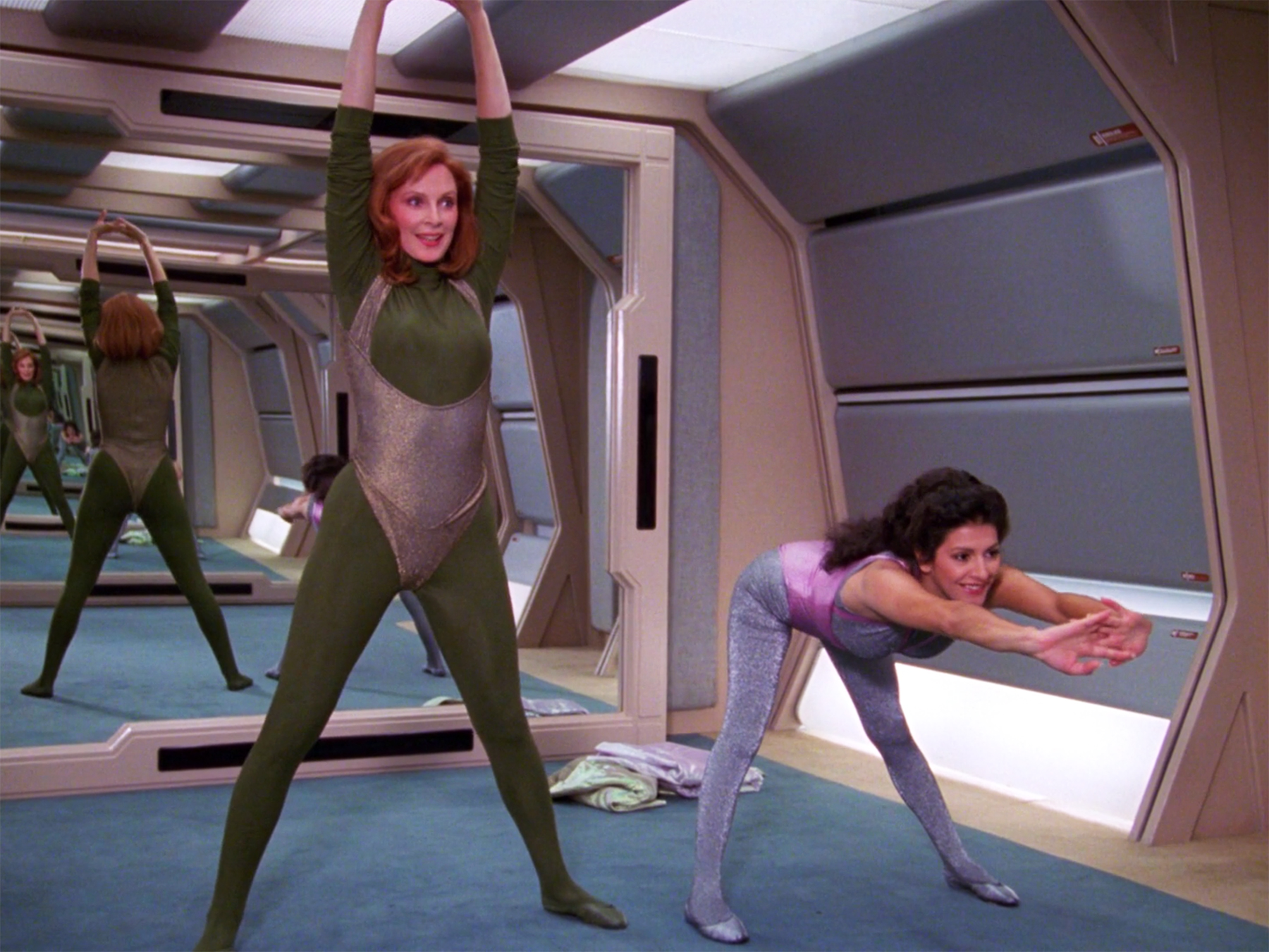
I’m very disturbed by the full body leotards that they squeeze Sirtis and McFadden into but how wonderful is it to see this show giving its female character time in the limelight to have some girl talk. Whilst they fail the Bechdel test horribly, these scenes are still very sweet and watchable and really well written. ‘Who needs rational when your toes curl up?’
Worst moment – This is one of the better examples of the Ferengi in TNG and they are still overwritten and overplayed. You have to wonder how their reputation to acquire profit is earned when they seem to blunder their way through all negotiations with little tact or finesse.
I wish they hadn’t done that – You could almost say that Ral violates Troi by walking into her office and manhandling her but she seems perfectly complicit in the act and seems to thoroughly enjoy having her hair messed around with. I don’t know if I have ever empathised with Troi more than I do with this episode.
A reason to watch this episode again – I really like this and it is another example of the confidence of the third season because if this had been aired in the first two years of TNG you know it would have been fairly dismal. Troi is never better in the entire show and if she was characterised with this much honesty and sensuality throughout the run, there’s a possibility that she might have been one of my favourites. Marina Sirtis seems to enjoy the chance to be in the spotlight and seems visibly more relaxed than she has ever been before. I find her relationship with Ral very believable because there is nothing sensitive about it. It’s an instant attraction, provocative and charged and the two of them dive into it consensually. Even better, when Troi gets on her high horse, Ral manages to throw many of her criticisms of how he conducts himself back at her in some very winning scenes. I found myself nodding along to so much of this episode. The wormhole plot lacks tension or drama, so that end of the episode is severe lacking but I would take an underwhelming plot in favour of this much exceptional character work any day of the week. It’s a shame that an enjoyable TNG episode should encourage such a dismal Voyager one as the weakest element of The Price winds up being followed up in False Profits.
***1/2 out of *****
Saturday, 24 October 2020
TOS – The Apple
Plot – For the first third of The Apple the dangers that come aren’t particularly compelling and they come at a snail’s pace. The flowers of death, the fact they cannot beam off the planet, the man who is following them…these things play out in a very slow manner. What those early scenes needs is long shots and location work to try and sell it as a real world with deadly dangers. Instead we get the usual studio set with plastic flowers and not enough plants to make it feel like a jungle planet. It feels artificial, and so does the danger. We’ve waiting for the point where Kirk takes down the computer and makes a speech about the independence of the slaves, with a dreadful joke about love. Ultimately it feels like the entire exercise has been for the express purpose of making a joke about Spock looking satanic, as that was the reason why an exec didn’t want his character to appear on the show. It really wasn’t worth the bother.
Character – Chekov attempts to get close to the only female member of the landing party when Kirk breaks them up and says that is not why they have beamed down to paradise. I would punch the air at his observation if it wasn’t for that fact that that is exactly what Kirk gets up to every other week.
I thought it was very funny that Kirk should try and rouse Spock with the reminder ‘do you know how much time Starfleet has invested in you?’ It’s strange how Kirk falls to pieces over the death of one of his officers that we have never heard of before. Surely it is the Captain’s job to make these tough decisions and should people fall in the line of duty (as they inevitably do under Kirk) then he knows they walked into any situation understanding the risk. It takes Spock to snap him out of it and remind him that nobody has ever stated that Starfleet duty is particularly safe. Kirk seems to think that his men are dead because he let himself get distracted by the smell of flowers…or something. Kirk would go on to lose many more men before the end of three series and he wouldn’t even bat an eyelid. By the time he is threatening to get rid of Scotty if he doesn’t get the warp engines working, you have to conclude that there is something seriously off about him this week. After he makes his wrap up speech to the indigenous population at the end of the episode, I wish McCoy had mentioned that he was really out of character on this little jaunt. Oh, and how he has seemed to have forgotten about the men who have died.
Your standard Spock/McCoy philosophical battle ensues but I have seen it done far more effectively elsewhere. The best thing about this argument is the performances. Nimoy and Kelly make such an engaging pair when they are squaring off against each other.
Great Dialogue – ‘Would you mind being careful where you throw your rocks, Mr Spock?’
Terrible Dialogue – ‘If you can’t get those warp engines fixed…you’re fired!’ Poor Mr Scott, stuck between his defunct and damaged engines and facing career oblivion. I wouldn’t say this is Kirk’s best day for employee morale.
Production – They have made a valiant effort to provide the episode with the Eden that everybody seems to think this planet is. I don’t know if I would have gone for the blood red sky that gives the planet an oppressive feel. The giant snake head of Vaal is impressive (it is carved out of rock with smoke bellowing from its eyes) but it is also where a lot of the money of this episode has been spent and so it is obviously over exposed.
Worst moment – Surely that is record time for a redshirt to meet his demise? Two minutes in one of them explores the foliage on this world and is pierced by the pollen. When Kirk sends two nobodies called Mallory and Marple ahead but tells them to be careful he is basically sending them down the mine like canaries. I would have requested a sojourn back to the ship immediately.
Vaal is the worst computer that TOS ever featured because it doesn’t even have any kind of personality. It doesn’t speak or have a chance to get its point of view across, it merely has meek inhabitants of this world do its speaking.
I wish they hadn’t done that – It is irritating that the only observations that the Yeoman can make are about how frightening the situation is and questions about sex. Like those are the only things that would concern a female officer in Starfleet. This is salvaged slightly by the scene where she beats the crap out of several of the primitives.
The sequence of the two primitives watching Chekov and the Yeoman kissing and deciding they would like a bit of that feels really off kilter. I’m not sure who these scenes are aimed at or whether we are supposed to be titillated or disturbed. Watching aliens learn how to make love isn’t my idea of entertainment and we certainly aren’t invested enough in these characters to care about their relationships with each other.
A reason to watch this episode again – This might be an episode that would work for kids with the landing party beaming down to a jungle planet and the redshirts (everybody should know there is going to be a massacre because so many of them accompany Kirk) being bumped off in a variety of ways. Exploding rocks, plants that spit deadly pollen, lightning that strikes you down…it looks like Max Ehrlich had great fun trying to think up really silly ways to murder this bunch. As an adult it is very slow and unconvincing, taking an age to get to the point. Any excitement is purely superficial and by the end we are dealing with another enraged supercomputer with too many processors missing. How many times can TOS wheel out that old trope? An infinite amount by all accounts. The shifts in tone are quite alarming too. It takes a confident show to skip from horror planet to dining with primitives to philosophical debate hour. The trouble is these all feel like different episodes lumped together. It’s pretty jarring. It’s packed with TOS clichés and none of them are handled in a particularly clever way. When the red painted primitives start prostrating in front of a computer dressed up like a snake God you might find yourself looking over your shoulder and hoping nobody comes in and sees what you are watching. It’s one of those 60s episodes where I was watching the clock.
*1/2 out of *****
Character – Chekov attempts to get close to the only female member of the landing party when Kirk breaks them up and says that is not why they have beamed down to paradise. I would punch the air at his observation if it wasn’t for that fact that that is exactly what Kirk gets up to every other week.
I thought it was very funny that Kirk should try and rouse Spock with the reminder ‘do you know how much time Starfleet has invested in you?’ It’s strange how Kirk falls to pieces over the death of one of his officers that we have never heard of before. Surely it is the Captain’s job to make these tough decisions and should people fall in the line of duty (as they inevitably do under Kirk) then he knows they walked into any situation understanding the risk. It takes Spock to snap him out of it and remind him that nobody has ever stated that Starfleet duty is particularly safe. Kirk seems to think that his men are dead because he let himself get distracted by the smell of flowers…or something. Kirk would go on to lose many more men before the end of three series and he wouldn’t even bat an eyelid. By the time he is threatening to get rid of Scotty if he doesn’t get the warp engines working, you have to conclude that there is something seriously off about him this week. After he makes his wrap up speech to the indigenous population at the end of the episode, I wish McCoy had mentioned that he was really out of character on this little jaunt. Oh, and how he has seemed to have forgotten about the men who have died.
Your standard Spock/McCoy philosophical battle ensues but I have seen it done far more effectively elsewhere. The best thing about this argument is the performances. Nimoy and Kelly make such an engaging pair when they are squaring off against each other.
Great Dialogue – ‘Would you mind being careful where you throw your rocks, Mr Spock?’
Terrible Dialogue – ‘If you can’t get those warp engines fixed…you’re fired!’ Poor Mr Scott, stuck between his defunct and damaged engines and facing career oblivion. I wouldn’t say this is Kirk’s best day for employee morale.
Production – They have made a valiant effort to provide the episode with the Eden that everybody seems to think this planet is. I don’t know if I would have gone for the blood red sky that gives the planet an oppressive feel. The giant snake head of Vaal is impressive (it is carved out of rock with smoke bellowing from its eyes) but it is also where a lot of the money of this episode has been spent and so it is obviously over exposed.
Worst moment – Surely that is record time for a redshirt to meet his demise? Two minutes in one of them explores the foliage on this world and is pierced by the pollen. When Kirk sends two nobodies called Mallory and Marple ahead but tells them to be careful he is basically sending them down the mine like canaries. I would have requested a sojourn back to the ship immediately.
Vaal is the worst computer that TOS ever featured because it doesn’t even have any kind of personality. It doesn’t speak or have a chance to get its point of view across, it merely has meek inhabitants of this world do its speaking.
I wish they hadn’t done that – It is irritating that the only observations that the Yeoman can make are about how frightening the situation is and questions about sex. Like those are the only things that would concern a female officer in Starfleet. This is salvaged slightly by the scene where she beats the crap out of several of the primitives.
The sequence of the two primitives watching Chekov and the Yeoman kissing and deciding they would like a bit of that feels really off kilter. I’m not sure who these scenes are aimed at or whether we are supposed to be titillated or disturbed. Watching aliens learn how to make love isn’t my idea of entertainment and we certainly aren’t invested enough in these characters to care about their relationships with each other.
A reason to watch this episode again – This might be an episode that would work for kids with the landing party beaming down to a jungle planet and the redshirts (everybody should know there is going to be a massacre because so many of them accompany Kirk) being bumped off in a variety of ways. Exploding rocks, plants that spit deadly pollen, lightning that strikes you down…it looks like Max Ehrlich had great fun trying to think up really silly ways to murder this bunch. As an adult it is very slow and unconvincing, taking an age to get to the point. Any excitement is purely superficial and by the end we are dealing with another enraged supercomputer with too many processors missing. How many times can TOS wheel out that old trope? An infinite amount by all accounts. The shifts in tone are quite alarming too. It takes a confident show to skip from horror planet to dining with primitives to philosophical debate hour. The trouble is these all feel like different episodes lumped together. It’s pretty jarring. It’s packed with TOS clichés and none of them are handled in a particularly clever way. When the red painted primitives start prostrating in front of a computer dressed up like a snake God you might find yourself looking over your shoulder and hoping nobody comes in and sees what you are watching. It’s one of those 60s episodes where I was watching the clock.
*1/2 out of *****
Wednesday, 21 October 2020
VOY – Repentance
Plot – You can’t accuse Repentance of not getting to the point straight away. It is an episode that hits the ground running with the story already well within progress, a ship about to be destroyed, its crew beamed aboard Voyager and a Seven of Nine attacked in sickbay. I wish more Voyager episodes had this kind of succinctness.
The premise of Voyager being the temporary prison to a number of convicted prisoners that are due to be executed is a strong one, and one where you can immediately see the chance to indulge in the kind of moral debate that Star Trek excels at. Janeway is discomforted by the idea of taking eight men to their deaths but (as ever) sticks by the Prime Directive. Seven is objective about the situation (she doesn’t understand why they would save the life of somebody who is going to be executed) and the Doctor finds the murder of criminals to be barbaric. The ‘favour the victims’ justice system that allows the family of the man murdered to choose what happens to the perpetrator of the crime is barbaric. How could they walk away with anything but a death sentence?Character – Good grief, an episode that gives Neelix something to do that isn’t perving over his underage girlfriend or forcing the crew to indulge in their culture. This is an ideal use of this character who used to be a bit of a rogue in the past and probably saw the inside of a prison cell or two himself. He’s empathetic and sweet, refusing to accept that somebody is simply good or evil. He knows that there is a story for each of these prisoners and he takes the time to talk to them and try and find out what it is. I really like the scene at the climax where Neelix realises that he has been had and confronts the man he thought he was trying to help. Neelix stops short of saying he is disgusted but it is written all over his face. His empathy was exploited.
Performance – Jeff Kober often plays these disreputable types in television shows and he does a fine job of bringing an element of ambiguity to Iko who often comes across as a psychopath but the episode takes the time to peel away layers and find that things are far more complicated than that. He makes the transition from cold killer to repentant victim swiftly and believably. It must be the kind of acting gig that most actors cry out for, one that really allows them to show their range.
FJ Rio (who has already played a very memorable role on DS9 as Muniz) has a harder job because he is a playing the victim of an unfair legal system. I really liked how he refused to play the part in an obvious way. This is a man who has been hardered by prison life, even if he was innocent and he still seems quite distrustful.
Production – The cells that they create to house the prisoners on Voyager are surprisingly cramped and ugly. It genuinely feels like a prison and the scenes that take place there are harshly lit and unpleasant to look at. For Voyager this is a huge step in a new direction because this show often likes to look pretty and stylish. I could have done with a lot more of this kind of thing – think The Chute.
Best moment – I love it when Janeway gets angry. There’s always fireworks to be had and I don’t think Kate Mulgrew has given a performance quite this passionate for some time.
The conversation between Neelix, Torres and Paris in the mess hall is far more subtle that you might think. Neelix has been investigating the felonious situation and is convinced that the Bantakans are being unfairly mistreated by a system that is convinced they are all criminals. It’s Torres and Paris’ reactions that compel me, because they are happy to believe in the word of law and to accept the ‘truth’ of the situation. As long as it doesn’t affect them, they are happy to overlook the fact that man have been unlawfully convicted. They’re us. It’s easy to judge from afar and dismiss the fate of men that the law has decided are criminals. Using Neelix as an advocate for justice is quite frankly the best use of him in years.
Worst moment – The unfortunate action sequence. That’s Voyager not trusting its audience to watch an issue show and be engaged with the ideas and performance alone. This isn’t an episode of Prison Break, it’s Star Trek.
I wish they hadn’t done that – The nanoprobes are once again being used a s a catch-all plot device. It might be an interesting avenue if it hasn’t been used ad nauseum before.
There’s an interesting angle that this episode takes at the 11th hour regarding Seven fighting for Iko because she is trying make amends for the crimes that she committed as a Borg. It’s beautifully played and well written but it adds another element to the mix of this episode and it is one too many. If that was what this episode was supposed to be about then they should have found a way to explore it much sooner. Personally, I would have given this episode over to Neelix and his investigations and as a exploration of his past, because Seven has been explored to death at this point. Like I said this isn’t bad material (quite the opposite) but it is a very obvious route to go down.
A reason to watch this episode again – It’s a shame that Repentance doesn’t get more attention because it is exactly the sort of episode I would have liked Voyager to have done more of during its run time. A powerful little story featuring Trek morality, and one that allows us to look at the journey home in a completely different way (turning the ship into a prison for prisoners on death row). How interesting would it have been if this had taken place during season four or five and the prisoners had been forced to stay on the ship for the rest of the shows run? The direction and design are surprisingly brutal for Voyager but that doesn’t surprise me with Mike Vejar at the helm. I’m not sure that Repentance is especially likable (which is probably why most people have chosen to forget about it) but it is thoughtful and it has some interesting things to say about capital punishment. Pleasingly it doesn’t force an opinion down the viewers throat, it presents all of the characters and the situation they are in, shows us the different crews’ reactions and then asks you to decide for yourself. I’ve heard the complaint that because this episode puts its premise through a fantasy lens (of course it does, it’s sci-fi) that it guts the situation of reality but you could aim that at pretty much any Star Trek episode (does Far Beyond the Stars becomes any less powerful when it is revealed that it is merely a false vision delivered to Sisko from the Prophets?). The subject matter is dark enough and the morality is ambiguous that this could have been a DS9 episode and I cannot think of a higher compliment. Excellent scenes for Neelix, Seven and Janeway.
***1/2 out of *****
Tuesday, 20 October 2020
The Nimon Be Praised! (Plus One) Discuss The TV Movie (and The Caves of Androzani!)
Two new podcasts this week and one with an exciting new guest star - the creator of our memorable and striking artwork, Kayla!
Jack & Joe are back! This week they are discussing an undisputed classic...or perhaps they are about to dispute that? Is Nicola Bryant a little too good in the role of the sexually targeted victim? Is this the best directed Doctor Who story? Are there any redeemable characters here? And should this be going out at teatime? All this and a trailer for the next four episodes...featuring guest stars!
Join Jack, Joe and special guest star Kayla (creator of the podcast artwork) as they head to San Fransisco 1999 for the start of Paul McGann’s prolific reign as the Doctor. Just who was the most vital minor character? How camp can Eric Roberts go? Is this a movie or a pilot? All this and so much more laughter and high jinks.
Subscribe to:
Posts (Atom)