

My Struggle written and directed by Chris Carter

What’s it about: ‘We have a problem. They’ve re-opened The X-Files…’
Brains’n’Beauty: ‘As a scientist it’s probably some of the most intense and challenging work I’ve ever done. I’ve never felt so alive…’ Aged but seemingly more beautiful than ever, how can we do anything but celebrate the return of Gillian Anderson to The X-Files? To me, the real acting chops of the show and with the ability to handle emotion and action with equal aplomb, it was appalling how she became a side character in the show that she helped become a phenomenon in the previous season of the show (this isn’t a dig at series nine, which has it’s shining moments, just Scully’s role within it) and reduced to simply caring for her child and pining after Mulder. It’s time for her to take a more active role in the series again. She’s done with UFOs these days, practicing autopsy related business at the FBI and having long moved on from the strangle hold of conspiracies that stopped her life from moving. Scully isn’t sure that she is ready to attempt to bring down the government again, but she also doesn’t think she has a choice.
Trust No-One: Scruffy and dejected, Mulder doesn’t exactly race onto our screens as the obvious hero. Instead the story takes it’s time to show how he has been missing the work with Scully, wasting his life for the last decade and unable to move on from the paranoid ideas that fuelled him in his younger days. It was made explicit in the later seasons that Mulder and Scully were lovers (hence William) and The Truth and the last movie made that an integral part of their stories (indeed the bed scene between Mulder and Scully in The Truth was just about the only scene with any emotional honesty in the finale). But it’s clear much time has passed and whilst the reason is not made clear, they have separated but remain close friends who connect infrequently but are aware of the wealth of history and feelings between them when they do. Would I want a new series of the X-Files featuring Mulder and Scully as lovers? Isn’t that what killed off The New Adventures of Superman? I think this is played just right, some subtle touching, the promise that there is more between these two but a restrained distance between them for professional purposes. There’s an element of regret in Mulder’s voice when he says that he and Scully have moved on with their lives, both professionally and personally. Mulder’s depression killed their relationship and he frankly seems to be on the edge throughout this episode, drowning in paranoiac fantasies.
Paranoid Reporter: Ted O’Malley is like every paranoiac that Mulder has ever run into (including elements of Mulder himself) rolled into one. I’m not sure how this man gets through the day given that he thinks every part of life is manipulated, observed and directed. Fortunately, he is played by Joe McHale of Community fame, so it’s a charismatic performance despite his more annoying tendencies. When he says he is prepared to blow open the most evil conspiracy the world has ever known I wanted Mulder to yawn and say ‘been there, done that, failed.’ Is there an implication here that Scully slept with O’Malley? She’s seen in his limousine sipping champagne and he touches her in a very familiar way. Despite the fact that she is a free agent now, I hope that isn’t case. He’s such a slime ball and she’s never really been that sort of character.
Sparkling Dialogue: ‘No I only want to believe. Actual proof has been strangely hard to come by.’

Dreadful Dialogue: ‘It’s about controlling the past to control the future! It’s about fiction masquerading as fact!’ – this is Mulder’s genuine response when Skinner asks why he has returned to the X-Files office. You just want Skinner to say ‘but what are you really after?’ when faced with such ridiculously portentous dialogue.
‘You want to believe! You so badly want to believe!’ ‘I do believe!’ – it’s like a stuck record of the shows message that is almost comical in its extremes.
‘Sveta is the key to everything!’ – just like Cassandra was the key to everything in Two Fathers/One Son, just as William was the key to everything in Provenance/Providence… Someone turn the bloody key and expose this thing then!
Ugh: Nothing truly disgusting to report, unfortunately.
The Good: Firstly, may I say how glorious it is to have The X-Files back in whatever form it choices to take. The first new season might be a little shaky to begin with but just to be able to complete an X-Files marathon and not have to conclude with The Truth and I Want to Believe is a godsend. And one that I never thought would happen if I’m honest. Now the show is really up and running it is delivering episodes of real worth again, and The X-Files on form is about as good as television gets and for that we should be grateful (even if we do have to trawl through some dreary Chris Carter penned episodes to get there). It’s become very easy to criticise Chris Carter these days (I did it in the previous sentence) but his direction of this material is often very strong and the early scenes of the saucer being discovered are shot with cinematic production value and have a real sense of menace. The X-Files was always very good at creating suspicion around documented events and O’Malley’s suggestion that 9/11 was conjured up by the government as a distraction technique is so terrifying (admittedly something I have heard mooted before but dismissed as being ridiculous) in its implications I’m surprised that the show didn’t have the balls to run with that idea for its opener. I also like the assertion that there has been a source of ‘free energy’ since the 40s, but it has been more lucrative to sell oil for trillions of dollars instead. The show has always traded on the notion of alien technology being misused in the governments hands but the idea of dismissing the aliens themselves as long dead and that this entire nine-season escapade has been of human design using alien tech from the crashed Roswell spaceship…well that says something rather ugly about ourselves and how willing we are to go to progress. It doesn’t make any sense given everything we have seen in the series so far, especially scenes like those in the first movie where Mulder came face to face with alien life. But at least Carter is trying to see the series through a new angle.
‘Sveta is the key to everything!’ – just like Cassandra was the key to everything in Two Fathers/One Son, just as William was the key to everything in Provenance/Providence… Someone turn the bloody key and expose this thing then!
Ugh: Nothing truly disgusting to report, unfortunately.
The Good: Firstly, may I say how glorious it is to have The X-Files back in whatever form it choices to take. The first new season might be a little shaky to begin with but just to be able to complete an X-Files marathon and not have to conclude with The Truth and I Want to Believe is a godsend. And one that I never thought would happen if I’m honest. Now the show is really up and running it is delivering episodes of real worth again, and The X-Files on form is about as good as television gets and for that we should be grateful (even if we do have to trawl through some dreary Chris Carter penned episodes to get there). It’s become very easy to criticise Chris Carter these days (I did it in the previous sentence) but his direction of this material is often very strong and the early scenes of the saucer being discovered are shot with cinematic production value and have a real sense of menace. The X-Files was always very good at creating suspicion around documented events and O’Malley’s suggestion that 9/11 was conjured up by the government as a distraction technique is so terrifying (admittedly something I have heard mooted before but dismissed as being ridiculous) in its implications I’m surprised that the show didn’t have the balls to run with that idea for its opener. I also like the assertion that there has been a source of ‘free energy’ since the 40s, but it has been more lucrative to sell oil for trillions of dollars instead. The show has always traded on the notion of alien technology being misused in the governments hands but the idea of dismissing the aliens themselves as long dead and that this entire nine-season escapade has been of human design using alien tech from the crashed Roswell spaceship…well that says something rather ugly about ourselves and how willing we are to go to progress. It doesn’t make any sense given everything we have seen in the series so far, especially scenes like those in the first movie where Mulder came face to face with alien life. But at least Carter is trying to see the series through a new angle.
The Bad: What’s interesting about the pre-titles gush of exposition is that the show hasn’t really tried to re-invent itself for a new generation. It is presenting the information with stylish, channel hopping rapidity that might appeal to the yoof of today but the essentials of the show (government cover-ups, aliens amongst us, a moral crusader) are still unchanged. Maybe a dynamic new approach to the show was needed to really grab people’s attention. Wow, going back to the old old title sequence of seasons 1-7 is a crazy nostalgia fest, but seems illogical given how much Duchovny and Anderson have aged since the show first aired in the 90s. is Skinner really being mooted as a bad guy again? His friend/foe relationship with Mulder and Scully is becoming more complicated and repetitive than the Ross/Rachel thing was on Friends. Series eight and nine firmly established Skinner as a friend to the X-Files and Scully and he was in full on protective mode. How the hell can they be suspicious of him again…unless that is just the factory setting that Carter thinks the show should be returning to. It feels like it is making a mockery of the (pretty wonderful) character work in the shows last two seasons. The last-minute re-introduction of The Smoking Man (yeah, he deserves the capital T) is supposed to be a shock twist…but really it left me groaning as another piece is slotted into place to make this business as usual. How the hell did he survive death this time? He escapes purgatory more times than Doctor Who’s The Master. He needs a ‘I’m indestructible, the whole universe knows that!’ style line to cover his miraculous survival again and again.
Pre-Titles Sequence: How on Earth do you even begin to sum up the entire nine seasons of The X-Files for the post-9/11 audience fifteen years after it went off the air? How do you sum up the entire convoluted, beautifully executed, emotional, thrilling, and occasionally unsatisfying journey? With a few pictures and a voiceover, apparently. Essentially what the pre-titles sequence of My Struggle is trying to do is what The Truth was trying to achieve at the end of season nine, only it does it in about five minutes rather than two long, hideous hours. Whilst people might have flashes back to the interminable days of Redux (the ultimate voice over episode that kick-started season five), Mulder presents a compelling case for the existence of extra-terrestrials in this sequence, backed up by some exhilarating and amusing sequences of flying saucer sightings. At this point I’ll take the clichés because it’s simply so wonderful to have Mulder and Scully back. As for the flying saucer that crashes into the desert, it’s a powerful visual and shows just what the advancements of CGI can do for the show in the modern age.
Orchestra: Who else but Mark Snow could score this show? He’s back on the synthesisers and wallpapering every scene with his trademark suspicion and distrust, occasionally bringing in some beautiful piano work to add some depth. Having reached the mid-point of the eleventh season I have to say he has been experimenting with some really up to date music techniques but at this point it’s still a little touch of the early 2000s, which might not be such a bad thing to bridge the gap between series nine and ten.
Pre-Titles Sequence: How on Earth do you even begin to sum up the entire nine seasons of The X-Files for the post-9/11 audience fifteen years after it went off the air? How do you sum up the entire convoluted, beautifully executed, emotional, thrilling, and occasionally unsatisfying journey? With a few pictures and a voiceover, apparently. Essentially what the pre-titles sequence of My Struggle is trying to do is what The Truth was trying to achieve at the end of season nine, only it does it in about five minutes rather than two long, hideous hours. Whilst people might have flashes back to the interminable days of Redux (the ultimate voice over episode that kick-started season five), Mulder presents a compelling case for the existence of extra-terrestrials in this sequence, backed up by some exhilarating and amusing sequences of flying saucer sightings. At this point I’ll take the clichés because it’s simply so wonderful to have Mulder and Scully back. As for the flying saucer that crashes into the desert, it’s a powerful visual and shows just what the advancements of CGI can do for the show in the modern age.
Orchestra: Who else but Mark Snow could score this show? He’s back on the synthesisers and wallpapering every scene with his trademark suspicion and distrust, occasionally bringing in some beautiful piano work to add some depth. Having reached the mid-point of the eleventh season I have to say he has been experimenting with some really up to date music techniques but at this point it’s still a little touch of the early 2000s, which might not be such a bad thing to bridge the gap between series nine and ten.

The Truth: ‘The tentacles reach far back into the last century but it wasn’t until victories in Europe and Japan and the onset of the Cold War that political and economic conditions became perfect for actual execution. A conspiracy bigger and more secret than the Manhattan project. No sooner had we defeating Germany that a new threat had started appearing the skies over America, drawn to Earth by the latest threat to extinction: The H-Bomb. Explosions acting as transducers drawing alien lifeforms through wormholes in spaceships using electro-gravitic propulsion. Advanced extra-terrestrial species visiting us, concerned for mankind and the threat of our self-destruction, forestalling our own annihilation through their own self-sacrifice. World leaders signed secret memos directing scientific studies of alien technology and biochemistry. Classified studies were done at military installations, extracting alien tissue. Test were done on unsuspecting human subjects, in elaborately staged abductions, in craft using alien technology recovered from the downed saucers. Including human hybridization through gene editing and forced implantation of alien embryos’ ‘A government, hiding, hoarding alien technology for 70 years, at the expense of human life and the future of the planet. Driven not only by corporate greed but a darker objective’ ‘The takeover of America’ ‘And then the world itself by any means necessary. However violent, or cruel, or efficient. By severe drought brought on by weather wars conducted secretly using Ariel contaminants and high altitude electromagnetic waves. In a state of perpetual wear to create problem-reaction-solution scenarios to distract enrage and enslave American citizens at home with tools like the Patriot Act and the National Défense Authorisation Act, which abridged the constitution in the name of national security. The militarisation of police forces in cities across the U.S. The building of prison camps by the Federal Emergency Management Agency with no stated purpose. The corporate takeover of food and agriculture, pharmaceuticals and health care. Even the military in clandestine agendas, to fatten, dull sicken, and control a populace already consumed by consumerism. A government that taps your phone, collects your data and monitors your whereabouts with impunity. A government preparing to use that data against you when it strikes and the final takeover begins. The takeover of America by a well-oiled, well-armed multinational group of elites that will cull, kill and subjugate. It’ll probably start on a Friday. The banks will announce a security action necessitating their computers to go offline all weekend. Digital money will disappear. Followed by the strategic detonation of electromagnetic pulse bombs to knock out major grids. What will seem like an attack on America by terrorists or Russia or a simulated alien invasion using alien replica vehicles that exist and are already in use.’
It is literally as though Carter has been stewing on these paranoid fantasies for 15 years and has to get them all out in one go. It’s quite one of the most preposterous dialogue sequences in the shows entire run, an endless stream of exposition, delivered threateningly, that just keeps coming like a mighty river of paranoia and smacks you in the face with a sheer wall of madness. These people don’t sound like characters but propaganda machines. And the ideas that are being mooted are so extreme that you have to wonder why Scully didn’t just burst into laughter at the end. I think Carter was hoping that if he listed one theory after another in quick succession that we wouldn’t have time to think about them and just be carried along with the tide of suspicion. Here you have the time to read the whole scene and see for yourself how irrational it all sounds. What’s more, the intercutting of so many pieces of history and newly filmed footage is so expertly done that despite the madness of it all you actually start to wonder…what if it is true? Skipping from drama to a documentary style piece about the corruption of society by the government. Whatever you might think about all this, it is pure X-Files. Part ludicrousness, part fact, part intriguing ideas. At least Carter cannot be accused of not dishing out answers this time. And Scully says that it is so bogus and ridiculous it borders on treason. The voice of reason. Unbelievable that the series is going down the route that the scenario quoted above has some merit, as Sveta and Scully’s test results seem to give it some element of credence.
Moment to Watch Out For: The scenes of Mulder in the hangar with the alien spacecraft. There’s no sense of epic wonder in these scenes because we’ve done all this before. Instead Mulder walks up to the beautifully designed ship that is defying gravity and cloaking itself like an old friend he is coming home to. It’s a fantastically executed sequence, more impressive camerawork from Carter.
Result: The X-Files is back after 1.5 decades away from our screens! Put your hands together for the return of Mulder and Scully in the post 9/11 period, where paranoia runs amok more than ever. Surely this is the perfect time to have the dynamic duo back to cut a swathe through all the outlandish theories that are generated as a result of some ghastly real-life events in the intervening 15 years since the show was off the air? And as a chance to update the show for a modern audience it is an irresistible opportunity, taking the Game of Thrones approach of truly cinematic television with visceral shocks, heart-in-mouth twists and turns and dynamic storytelling. Unfortunately, that is an opportunity Chris Carter seems to want to ignore, instead taking us right back to the early 2000s and practically picking up the show where we left off. There are little concessions made here for the fact that the entire landscape of television has changed in 15 years and Carter is still fixated on long voiceovers, extended dialogue scenes and muddled writing that trades discussing ideas over experiencing them. Even Mulder and Scully, who have professed to have moved on from The X-Files in all this time are drawn back together to partner up and tackling paranormal crimes again. It’s like nothing has changed and we’re picking up from the end of series seven. Despite the leads ageing, this episode could come after Je Souhaite. I’m going to sound contradictory here, but this is rather enjoyable for all its fossilisation. Carter has this schtick down pat and it’s been a long time since we’ve enjoyed Mark Snow’s synthy music, Duchovny’s droning voiceovers, Anderson’s ability to emote through some tangled exposition, seductively long shots of crashed flying saucers, clandestine scenes in darkened car parks and quite so many conspiracy theories all packed into one hour. My Struggle is certainly never dull, it’s packed full of arresting visuals and the performances, which you might expect to be rusty, feel as though the leads have never been away. Carter directs much better than he writes (characters are often choking on his expository dialogue and mission statements) and the whole piece, whilst oddly paced, skips along regardless and there is a real sense that something terrible is brewing. I’m really happy to have The X-Files back and I’m looking forward to what was my personal favourites of their original body of work, the monster of the week episodes. What the show needs its pacier storytelling, not just a slide show of ideas and a stronger emotional core to justify Mulder and Scully being brought together again. Fortunately, these things would eventually be delivered: 6/10
Founder’s Mutation written by written and directed by James
Wong

What’s it about: Evil Doctor, experiments on babies, alien
DNA in the mix, mothers being exploited…
Brains’n’Beauty: You’ve gotta love Scully’s assertion that
she’s old school, pre-google. She actually reads books and retains information,
an appalling concept in the digital age. The first time Scully and Mulder are
poking around a darkened room with flashlights Anderson must have felt right at
home again. You’ve got fresh images for the title sequence right there. There’s
a personal connection to Scully, linking to the hospital that she has worked in
for the past seven years. It’s nice to see that explored a little more, even if
it is just seeing how well she is respected at the hospital. Brilliantly this
ties in with Scully’s abandonment of William in the episode of the same name in
series nine, with Scully weighed down with the regret of a decision that made
sense at the time. Speaking as somebody who was invested in the final two
seasons of the series, I was appalled that I went on the protracted and
incredible journey in series eight to bring William to life and then the
part-professional/part-domestic arrangement of series nine with Scully holding
the baby and the gun, only to have him given up for adoption so close to the
series’ conclusion. It felt as though the writers simply did not know how to
resolve the William storyline that suggested he had great powers and might be
the new messiah of an alien cult and so they simply chose to remove him from
the series. I stick by my assertion that it was a spiteful thing to do with
Scully (Anderson agreed) and to the audience that had softened to this domestic
take on the show, because nobody knew at the time that there would be a new
series 15 years later to deal with the aftermath of that decision. Colour me
impressed that they have then, and that her adoption choice has been a conduit
to some brutal drama in series 10 and 11. The absence of William has left an
unspoken gap between Mulder and Scully and has given Gillian Anderson the
chance to do what she does best, to look emotionally pained and devastate the
audience with it. Let’s see if these references to William actually lead
anywhere or if this is just teasing the audience. For now, it is an emotional
hook for the series to pick up and stab at the audience with. A very effective
one, because the bond between mother and son is a powerful one and cutting it
leaves both parties damaged and those effects are fascinating to examine. The
dream sequences are painful because they are so sunnily directed, an idyllic
picture of motherhood and the sort of occasions that Scully denied herself.

Trust No-One: Mulder is back to his unorthodox ways of
investigating, attempting to remove classified hard drives and taking the
mobile phone from the body of the first victim. Scully offers token disapproval
but she knows his approach gets results. Even Skinner tows the line with
warnings to Mulder that he isn’t allowed access to certain sensitive
information, before whispering that he assumes that he made copies. Mulder has
his own dream sequences about fathering William, teaching him the things that
are important to him. Like Scully, he is scared that ultimately he will come to
some ghastly extra-terrestrial fate, and pleasingly this plays out along
similar lines to Samantha’s abduction. The regret that they both have that
their son is no longer in their lives is palpable.
Sparkling Dialogue: ‘This could be dangerous’ ‘When has that
ever stopped us before?’
‘Desire is the devils pitchfork’ – the quality of mercy is
not Sister Mary who, in a quiet rant of religious intolerance, exposes the
dangerous ethics of the left wing who claim morality as their own yardstick.
Condemning all men, regardless of the circumstances. There are many men out
there who have done terrible things to women, but not all of them. To think
that is unnecessarily condemning.
‘Every new species begins with a Founder’s mutation.’

Ugh: Poor Sanjay stabs himself in the ear with a letter
opener to try and stop the insistent whining that is driving him mad…and when
that doesn’t work he keeps on pushing. I let out a cry of disgust of the sort I
used to on a regular occasion with The X-Files. Hooray for James Wong, who
remember that this show used to gross us all out more than most. We see the
opener extracted from his ear practically in slow motion, covered in blood and
gunk. Lovely. The children at Goldman’s facility shouldn’t make me recoil
because they are disfigured but some of the makeup is so effectively repellent,
I did anyway. Agnes’ murder and her baby being surgically removed is utterly
repulsive, just to get rid of the evidence that she was part of Goldman’s
experiments.
The Good: Homosexuality was rarely touched upon in the first
nine series of the show and so it feels very ‘now’ to be dealing with such a
hotly debated subject in the reboot. Sanjay is a tragic character who never
truly came to terms with his sexuality and had to live a double life to satisfy
his needs. Speaking as somebody who has dabbled a fair amount in the past
couple of years you should trust me when I say there is an awful lot of this
about. I like how the mention of ‘his kids’ has a completely different meaning
to the one I was suspecting, opening out the story in a new direction. I love
the sequence of Molly breathing in water for ten minutes. Somehow this show
manages to shed any innocence from children and turn them into something truly
sinister. The final set piece of Molly and Kyle being reunited and causing
mayhem involving glass shattering, eyes bleeding and Mulder and Scully being
tossed about by rag dolls see Wong throwing every directorial trick in the book
to make this as effective as possible.
The Bad: We’ve gone from a quick mention of the X-Files
being re-opened to Mulder and Scully back in full swing investigating a good
old-fashioned monster of the week story with no real explanation in between of
how or why the department was opened and how they fell about being back at
work. At only six episodes, I guess the niceties like explanation have to be
skipped over to get to some proper standalone episodes. Relying on flashbacks
so much means that we’re not getting the meat of the story within the ‘present’
narrative. In My Struggle it was all speculation and clips, but in Founder’s
Mutation we’re being told a lot of the drama again, just things that have
happened in the past. It’s the curse of episodic television, if you only have
an hour to tell a story you have to use these devices to expand the story you
are telling.

Pre-Titles Sequence: It’s a dizzying and disorienting
opening set piece featuring a scientist who is plagued by terrible sounds and
can hear everybody talking in fast and slow motion. Wong throws every trick in
the book (especially aurally) to get the viewer on edge without ever telling us
what is actually going on.
The Truth: Women being used as incubators, their children
disabled in some way and taken from them and used in eugenics experiments. The
Department of Defence is funding their research to imbue these children with alien
DNA and observe the results. Orchestra:
Moment to Watch Out For: In a wonderful moment of confusion,
Mulder almost receives head in a toilet from a friend of the first victim,
rather than just the information that he is after. His reaction is priceless
and the idea that Mulder is repressed sexually given his extensive porn
collection and long game with Scully is hilarious. He should have just let go
and enjoyed it, I wouldn’t have thought anything less of him.
Result: This much more like The X-Files of old; an
intelligently written mystery that explores a horrific idea with plenty of cool
set pieces to keep the interest high. Everybody is very new to this again after
such an absence so it doesn’t feel quite as effortless as the best episodes of
the original run but there is plenty of substance and emotional truth in
Founder’s Mutation to make this a very worthwhile debut standalone adventure. I
complained in My Struggle that Chris Carter went on a whirlwind explanation of
a million paranoid fantasies without ever showing us the truth of any of them,
simply offering us a tiny titbit of proof in Sveta’s DNA. Wong instead builds
an investigation around one idea (the children being infected with alien DNA),
explores it inventively and emotionally with some lovely moments of horror and
ties it into a character study of Scully that adds a lot of depth to her return
to the series. It’s a story that is a little too dense, hence the flashbacks
and dream sequences to expand on the themes and give them some context, and
what starts as an investigation soon becomes a series of explanations. It pulls
a massive coup in the last ten minutes with the two kids set free and running
AWOL with their supernatural powers, an extremely vivid climax that more than
justifies the concept. There’s nothing in Founder’s Mutation that couldn’t be
solved with an extra 15 minutes to let the story breathe a little more but on a
scene by scene basis this is a strong episode, with memorably ghastly imagery
and dramatic moments. This a series gaining a little confidence but not quite
ready to fly and with just a little refinement this could have been a top tier
episode. Instead it’s a fascinating exercise in a show trying to remember what
it does best and in many ways beginning to perfect that formula again.
Founder’s Mutation is far more enjoyable than the season opener: 7/10
Mulder and Scully Meet the Were-Monster written and directed by Darin Morgan
Mulder and Scully Meet the Were-Monster written and directed by Darin Morgan

What’s it about: The old, old tale of a monster that is bitten by a human and starts to transform…
Brains’n’Beauty: I’m guessing Scully’s time running the X-Files has done her the world of good because I remember the days of Bad Blood (however Mulder remembered it) where she had to be dragged kicking and screaming onto cases. Now she is bringing the work to him and encouraging him to do the right thing even if he is going through a midlife crisis of sorts. In a wonderful moment Scully expresses that she loves her Mulder spouting all manner of conspiracy theories before declaring him batcrap crazy. Gillian Anderson lets go of all of her inhabitations (and her dignity) and throws herself wholeheartedly into the fake sex scene. How is she looking hotter than ever? Don’t you just love how Scully had this whole thing figured out long before the climax, and whilst Mulder is standing about pontificating with the creature she is off-screen solving this thing? She proves extremely capable, tackling the killer and wonderfully interrupts his perfectly rehearsed confession speech and motive.
Trust No-One: The simple joy of Mulder sitting in his office rummaging through X-Files and throwing pencils at his The Truth Is Out There poster whilst Scully pops in with a new job. Going through the archives with fresh eyes has proven humbling, especially when Mulder remembers the case where he thought a rock monster was on the loose and it turned out to be a publicity stunt for a landscaping business. He’s a middle-aged man (no he is…he is…okay Scully don’t rush in there to contradict him) who is wondering whether it is time to start putting away childish things. After everything that he has seen, Mulder still screams like a big girl when confronted by the Were-Monster. Mulder has an entire extended dialogue sequence where he flaunts every possible theory about the Were-Monster AND Scully’s obvious response too. They have been working together so long now. Mulder and Guy are the same, they both want to believe in things that aren’t real and in meeting, Mulder has proof that his quest for the unexplained can yield genuine results and Guy meets a human who is actually nice to him. The look of wonder on his face in the last scene where he finally sees the Were-Monster in its true form really melted me. Unlike most people who would have screamed or attacked or ran, Mulder is in awe and that thrill of the unknown is re-awakened in him.

Sparkling Dialogue: ‘We’ve been given another case, Mulder. It has a monster in it.’
‘Mulder, the internet is not good for you.’
‘I’m assuming Guy Mann is not a real name.’
‘A reminder that no matter how overwhelming our anxieties might be, they will soon be resolved when we are dead and buried for all eternity’ ‘Do you really think that’s sound therapeutic advice?’
‘You see now I possess the one Darwinian advantage that humans have over other animals: the ability to BS my way through anything!’
‘Because life’s hopeless. A few fleeting moments of happiness, surrounded by crushing loss and grief. Why bother?’
‘Man, she hit like a man!’ – The X-files not only promotes transgenderism, it slays it with comedy.
The Good: It’s a great point that nobody should be without evidence of supernatural phenomena these days because everybody has a camera on them. Cue Mulder heading into a dangerous situation and snapping photos like a crazy Instagram sensation. How wonderful that he had the lens pointed the wrong way so the only evidence he has is himself screaming like a great Jessie. One might expect the manager of a run-down motel to be something of a peeping tom but giant eyes cut out of the fox head hanging from the wall that Mulder discovers have to be seen to be believed. Poor Scully. A massive round of applause for Rhys Darby who gives a lovely performance as the monster, a guy who simply wants to get on with his life as a monster but is infected with humanity. It’s a lovely comment on the expectations modern day society when he realises that at a certain age you need to have achieved things in order to call your life a success. The reverse nature of the usual ‘bitten by a werewolf’ theme is beautifully handled and allows for Guy to experience the ‘horror’ of being a human. It’s a terrific moment when he jumps on the bed when he realises his monster nature has returned. I really like the idea that the monster of the week is the one who feels threatened of such mundane things like having to find a job and get a mortgage. The joy of a monster watching a human commit an act of such brutality and standing there, appalled. Wonderfully the mystery of the killings is resolved effectively too, with the killer hiding in plain sight but with the audience completely distracted by the very ‘human’ story of the Were-Monster.
‘I’m assuming Guy Mann is not a real name.’
‘A reminder that no matter how overwhelming our anxieties might be, they will soon be resolved when we are dead and buried for all eternity’ ‘Do you really think that’s sound therapeutic advice?’
‘You see now I possess the one Darwinian advantage that humans have over other animals: the ability to BS my way through anything!’
‘Because life’s hopeless. A few fleeting moments of happiness, surrounded by crushing loss and grief. Why bother?’
‘Man, she hit like a man!’ – The X-files not only promotes transgenderism, it slays it with comedy.
The Good: It’s a great point that nobody should be without evidence of supernatural phenomena these days because everybody has a camera on them. Cue Mulder heading into a dangerous situation and snapping photos like a crazy Instagram sensation. How wonderful that he had the lens pointed the wrong way so the only evidence he has is himself screaming like a great Jessie. One might expect the manager of a run-down motel to be something of a peeping tom but giant eyes cut out of the fox head hanging from the wall that Mulder discovers have to be seen to be believed. Poor Scully. A massive round of applause for Rhys Darby who gives a lovely performance as the monster, a guy who simply wants to get on with his life as a monster but is infected with humanity. It’s a lovely comment on the expectations modern day society when he realises that at a certain age you need to have achieved things in order to call your life a success. The reverse nature of the usual ‘bitten by a werewolf’ theme is beautifully handled and allows for Guy to experience the ‘horror’ of being a human. It’s a terrific moment when he jumps on the bed when he realises his monster nature has returned. I really like the idea that the monster of the week is the one who feels threatened of such mundane things like having to find a job and get a mortgage. The joy of a monster watching a human commit an act of such brutality and standing there, appalled. Wonderfully the mystery of the killings is resolved effectively too, with the killer hiding in plain sight but with the audience completely distracted by the very ‘human’ story of the Were-Monster.

Pre-Titles Sequence: All my warning systems started activating after the pre-titles sequence, which gives the impression that this was going to be one of those highbrow comedy episodes of The X-Files that is a little too self-referential for its own good. During the shows sixth and seventh seasons we were introduced to The X-Files lite, a glut of lighter, scare-free shows that could aspire to genius (The Unnatural) or plumbs new depths of depravity (First Person Shooter). Given that the revival was only going to be six episodes long did we really want to waste one of those on a comedy? I couldn’t really detect the pen of Darin Morgan in this opening scene, not yet, as I have come to expect something genuinely witty and wonderful from him.
Moment to Watch Out For: This is the first time that a monster on this show has been smacked in the face with a handbag being wielded by a screaming transgender prostitute. It’s quite one of the most absurd and hilarious things I’ve ever seen. His assertion that the monster was wearing ‘tighty whities’ is wonderful.
Result: ‘You’re going to have to put me out of my misery! I don’t want to wake up tomorrow and have to go to work!’ There has never been an X-File quite like this one before, not even from the pen of Darin Morgan. The definition of farce is ‘a comic dramatic work using buffoonery and horseplay and typically including crude characterisation and ludicrously improbable situations’ and that suits Mulder and Scully Meet the Were-Monster well, except perhaps the crude characterisation part and throw in a massive handful of fantastic one liners to the mix. It’s walking a tightrope of absurdity, but with all the actors giving winning performances and winks at the audience that are more pokes with a stick. Morgan mines a seam of comedy gold by bending the show out of shape and delivering a sequence of thoughtful dialogue scenes, great twists, reversals and observations. He writes unlike no other writer on television and that is entirely to his credit. If anybody was worried that Gillian Anderson and David Duchovny wouldn’t capture that magic that they had in the strongest seasons of the X-Files and were unsure about their tentative performances in the first two episodes then they need to look no further this little gem to see the alchemy of their rapport back in full swing. It helps that Morgan gives warm focus on their relationship and how happy they are to be working together again. With the focus on the monster of the week being a victim, this transpires to be a sweet character tale ultimately, with a terrific turn from Rhys Darby and a novel concept in the form of a monster of the week being bitten by a human and transforming into one. Confident, insane, very funny in parts and almost recognisably the show we’ve come to admire, Mulder and Scully Meets the Were-Monster is a unique one off that sits in the middle of the mini season ten and proudly glows. Prepare yourself for the funniest Scully sex scene of all time: 9/10
Home Again written and directed by Glen Morgan

What’s it about: Scully faces a personal crisis as the Trash Man is brought into being and attacks the heartless…
Brains’n’Beauty: Scully dealing with her dying mother is the sort of material that Gillian Anderson can take hold of and run with and she’s magnificent in Home Again. She fights back the tears as she tells her mother on her deathbed that her family, including William, which when she realises what she has said makes her choke some more. Brining Scully’s family into the equation really connects this into the series wider mythology and whilst I was happy that at least one member of the regular’s family made it out of the original run alive (because it felt for a time that there was an assassination squad, led by Chris Carter) that was gunning for them), it does feel like the right time to say goodbye to Margaret Scully. She’s both a Doctor and Margaret’s daughter and she has trouble separating the two. Margaret’s last words are about William, which really brings home the loss of her child to Scully. I’m not sure about this ‘we’ gave him up for adoption for his own good when it was clearly a decision on Scully’s part, one which she was terrified that Mulder would never forgive him for. She has a whole reef of questions that about William, about what he must think of her, of how her decision must have affected him. Having seen the majority of series eleven I know this is heading somewhere, and it is making me want to go back and watch series nine in a whole new light. Who ever knew the events of William would yield such dramatically satisfying results?
Trust No-One: Mulder steps in and speaks for the organ donor guys that have come for Scully’s mother, recognising that she isn’t thinking straight as she lays into them after she has died.

Sparkling Dialogue: ‘Not even in the proper recycling bin.’
‘I don’t care about the big questions right now, Mulder. I just want the chance to ask my mom a few more little ones.’
‘Mulder back in the day I used to do stairs and in three-inch heels.’
Ugh: How nice to have a monster that isn’t angst ridden (the previous two episodes featured tortured souls with monstrous powers) but one that is a soulless automaton that is out for retribution and will literally tear the limbs from people and throw them in the trash to get it done. The Trash Man is the most memorable nasty from the abbreviated season ten and his modus operandi, dismembering people with a smile, really sets him apart from the monsters of old.
The Good: Home Again doesn’t push its political agenda too hard (there’s no real time with a scary monster on the loose and Scully’s mum in critical care) but it essentially boils down to nobody is looking out for the homeless, everybody wants to push them off their own turf whilst pretending it is for their own good. Mulder cuts right to the heart of the matter when he tells both two squabbling officials that they are both speaking for their own interests, but who is speaking for the homeless?
The Bad: It’s a little jarring that Scully would just snap out of her breakdown over her mother’s death and just have to get back to work simply because the story that demands that she does so. Without the protagonists to investigate, the Trash Man story cannot conclude. It’s a very awkward transition. I’m not sure I understand half of what Tim Armstrong said, such was his unintelligible delivery. A shame because that’s where the moral of the story hits.
‘Mulder back in the day I used to do stairs and in three-inch heels.’
Ugh: How nice to have a monster that isn’t angst ridden (the previous two episodes featured tortured souls with monstrous powers) but one that is a soulless automaton that is out for retribution and will literally tear the limbs from people and throw them in the trash to get it done. The Trash Man is the most memorable nasty from the abbreviated season ten and his modus operandi, dismembering people with a smile, really sets him apart from the monsters of old.
The Good: Home Again doesn’t push its political agenda too hard (there’s no real time with a scary monster on the loose and Scully’s mum in critical care) but it essentially boils down to nobody is looking out for the homeless, everybody wants to push them off their own turf whilst pretending it is for their own good. Mulder cuts right to the heart of the matter when he tells both two squabbling officials that they are both speaking for their own interests, but who is speaking for the homeless?
The Bad: It’s a little jarring that Scully would just snap out of her breakdown over her mother’s death and just have to get back to work simply because the story that demands that she does so. Without the protagonists to investigate, the Trash Man story cannot conclude. It’s a very awkward transition. I’m not sure I understand half of what Tim Armstrong said, such was his unintelligible delivery. A shame because that’s where the moral of the story hits.

Pre-Titles Sequence: This is easily the most memorably grisly of the pre-title sequences of season ten. Being homeless is an undignified position enough to be in without being hosed down by the officials and forced to find somewhere else to squat. The man who is overseeing those orders, quite heartlessly I have to say, is then paid a visit by a stinking, cadaverous, hulking man who tears his limbs off and throws those bloody appendages in to the garbage truck he arrived in. And then gets in himself! The dismemberment is edited rapidly to shock and the whole sequence is directed with a forcefulness which the series has been lacking since it returned. This is a no hold barred X-Files set piece of old. The dust truck is a really good symbol of dread once it has been established that that is how the Trash Man turns up, as soon as we see it growling its way up the road in the distance you know that someone’s going to get it.
The Truth: A graffiti artist filled his art full of energy and thought and created the Trash Man, an avenging monster that can roam the streets and crush those people who treat human beings like trash. Like most X-File premises, don’t think about it too hard.
Moment to Watch Out For: I happen to have a great affinity for Petula Clark’s Downtown, it’s one of my favourite songs so I realise that I might be a little biased when it comes to using it to stage a particularly disgusting murder scene in Home Again. However, the sequence itself is brilliantly directed, packed with suspense, humour (the Trash Man recycles after he has murdered) and gross out horror. This is the sort of set piece The X-Files of old revelled in, and Morgan taps into that cold sweat of a something nasty invading your home vividly. ‘You may find somebody kind to help and understand you…’ indeed.
Result: ‘People treat people like trash…’ How like The X-Files to place a real monster of the week tale directly after one which subverts and pokes fun at the genre. Home Again reminds me of Leonard Betts from the series original run, whilst having an identity all of its own. It’s a grisly standalone with some memorably repellent set pieces, an emotional piece for Scully who is dealing with losing her mother and directed with both brutality (for the murder scenes) and lightness of touch (for the character moments), with some nice touches of humour throughout. It’s really very good indeed, the blueprint of what these episodes should be like. In terms of how visual storytelling has moved on in nearly two decades I have to say that this show feels like a bit of relic, with some long, protracted scenes and not really going for the kill during the horror moments but Morgan redresses this in his episode. He’s not exactly dragging The X-Files up to date but there is a directness and punch to this episode that pretty much all the others (except for My Struggle II strangely, as if Carter was learning how to bring this show back for a brand new generation as he went along) lack. Strangely, Carter would learn from this for series 11 where the show is literally dragged kicking and screaming into 2018, with some truly impressive direction throughout. The only real weakness I can see is how awkwardly Morgan tries to tie together the two stories thematically, because I’m not sure that the birth of a trash creature can really compare to the birth of Scully’s son. However, it brings the emphasis back onto William again, to be followed up later, and that can only be a good thing. ‘I need to believe that we didn’t treat him like trash’ is the punchline to the episode, just throwing her son away. I’m not such that gets down to the complexity of such a decision, but I appreciated the attempt to give her (very strange at the time) decision some context. Home Again packs in a lot but it does so with in very entertaining fashion, and I particularly loved the death scenes: 8/10
Babylon written and directed by Chris Carter

What’s it about: Terrorists, line dancing and doppelgangers…it has to be a Chris Carter script!
Brains’n’Beauty: Showing how far she has come since the early days of the show, Scully approaches Miller about his theory of being able to reach inside the mind of the terrorist boy because she wishes she had thought of that possibility when her mother was in a coma. Showing that she is open to extreme possibilities reveals growth to her character. Given her an emotional motive is a way of doing that intelligently.
Trust No-One: Mulder’s hyper crazy theory of the week (God I’ve missed those) is that somehow faith systems and thoughts have actual substance and can move men to do terrible things. Well, duh. Mulder and Miller believe that the young terrorist can be reached in ways involving magic mushrooms in order to receive intel on other terrorist acts that are about to be committed. It’s not the craziest premise for an episode, but it’s up there.

Brains’n’Beauty & Trust No-One Two: Enter Lauren Ambrose and Robbie Ammell as the Scully and Mulder for the next generation. Not only do they have a striking similarity to the agents physically (one redhead, one brown haired) but they also follow the same pattern of conflict in their work (Einstein is a sceptic and Miller a believer). The opening dialogue scene between the four characters is insanely fun with some wonderful reaction shots as they realise they practically exact replicas od each other. Anderson is especially funny as she reacts to Ambrose’s lines, the sort of lines she herself should be saying. Mulder thinks he seems like a bright young man, whilst Einstein pities Scully for being stuck down in the basement office. And like Duchovny and Anderson, the acting chops really belongs to the female side of this new arrangement. How Mulder and Scully pair off with their alternate partner made me chuckle and it really does feel, for a moment, like they are passing the torch to the next generation. After the sheer insanity they have experienced in this episode it is nice to see a wrap up scene for Einstein and Miller, showing that they have learnt something about themselves and situation and are ready for adventures new. I wish them every luck.
Sparkling Dialogue: ‘The earwitnesses.’
‘Nobody down here but the FBI’s most unwanted. I’ve been waiting 25 years to say that’ – whilst there have been one of two too many references to the shows past, this coming from the mouth of Scully is fantastic.
‘Because when I stand on a scale and think of ice cream my ass doesn’t grow!’
‘You talk to Agent Scully like that?’ ‘Only when she’s being a mugwump.’

The Good: Just a question really: why have so many of the writers this season directed their own work? Is it that they don’t trust for anybody else to bring justice to their words or simply the fact that this might have been a one hit wonder season and they all wanted to have their chance to get in the director’s chair one last time? Or is it simply because the great Kim Manners is no longer with us and nobody else could be trusted? There’s a very potent sequence involving a man silently building an explosive jacket whilst a news show plays in the background showing precisely the emotional stir that these terrorist acts brew up. Hate causing hate. Nobody wins. The dialogue maybe overwritten but Mulder and Scully pondering on how to reconcile love and hate in society really made my heart smile and is worth pondering on.
The Bad: I could have done without the scene where the official states his racist agenda and Scully steps in to point out that not all Muslims are terrorists. It’s probably quite contentious for American television but I was just left thinking ‘well obviously.’ The nurse who tries to take the young patients life in a wordless sequence is far more effective, because it asks you to decide whether what she is doing is right or wrong. Since Mulder didn’t actually take magic mushrooms are we to presume he simply has the ability to commune with the nearly dead? And has great line dancing skills?

Pre-Titles Sequence: Actually, my favourite pre-title sequence of the revival, and a strong contender for one of my favourite pre-titles ever. There’s a great deal to talk about here and whilst I do I am praying that I don’t insult any belief systems or intelligences, because the subject matter is so utterly inflammatory that simply saying that you appreciate the graphic power of a terrorist attack being portrayed on screen is enough to get you marked. Chris Carter was on very thin ice with this sequence because it is something that exists in the cold sweat of every American, but I think he directs it with a lot of honesty and integrity. Should The X-Files be tackling Islamic terrorism? If it wants to remain controversial and current, maybe yes. I’ve heard people say that this is a terribly racist sequence and completely inappropriate but the truth of the matter is that these sorts of things do happen. Capable, intelligent young men are convinced to give their lives in horrifically murderous ways that claim many victims along the way in the name of their religion. To shine a light on that isn’t racist, it is simply acknowledging that it happens. The direction here is phenomenal, showing the young man preying and eating, heading out to see his friends and acting in a very ordinary fashion. It means when the bomb goes off in the store that he enters it really provides a powerful shock. I liked how he is victim to racism on his journey, again acknowledging that this happens and how, for a moment, Carter turns this character into a victim. It’s such a provocative set piece because it stirs up at first feelings of sympathy and then feelings of hatred. It shines a light on our own feelings of racism and then terrorism. The way the camera fixes in one spot without music waiting for the inevitable explosion is brilliant, and the pyrotechnics afterwards filled my gut with horror. Not for the faint hearted and capable of jolting awake an audience that might have been relaxing after the last few weeks of The X-Files doing its usual monster of the week thing. What the young man does is abhorrent, but there is a suggestion here that he has been corrupted and isn’t entirely in control of his actions. Lots to ponder on.
Moment to Watch Out For: Mulder taking a trip in all senses of the word out of the hospital to attend a line dancing competition that he aces before being assaulted with denim tight booty, whipped seductively on an alien dissection table, whipped on a slave ship by the CSM and gets the intel from the terrorist that is being cradled in Mary’s arms. Religious imagery, funky direction, unconvincing effects, crazy music, impressive dancing, outrageous sexism and the return of some beloved characters all combine in a set piece that left me feeling as though I had crossed through fourteen different dimensions, switch channel several times and experienced auto erotic asphyxiation. Only Carter could produce this. God bless him.
Result: The episode so bad that most people find they spit on the floor when they mention its name. Well buckle up kiddos because I really loved Babylon, despite the fact that it has no serious clue what it wants to be. Is it a commentary in Islamic terrorism? Yes, at times. Is it a character piece where a younger version of Mulder and Scully are compared favourably against their older counterparts? For sure. Is it an expression of bizarro Chris Carter madness with a sequence featuring Mulder taking a drug trip, line dancing, hanging with the Lone Gunmen and being whipped provocatively by The Cigarette Smoking Man? Without a doubt. Logic is out the window and Babylon is all over the place in terms of tone, plotting and content. However, it is beautifully directed and acted, features some really enjoyable dialogue, a terrific score and somehow those elements (for me) blend into something that is truly unique and memorable. I walked away from the episode feeling a lot of appreciation of all of it’s constituent parts and when you bring them together jarringly into one episode it becomes a relentlessly out there journey. Babylon could only come from The X-Files and certainly it could only come from the pen of Chris Carter, a man who thinks he can literally get away with anything. Sometimes that God complex provokes eclectic and unusual results. Remember when the interaction between Mulder and Scully had started to become a little stale in series seven? Their time away has done both actors the world of good and now there is a beautifully relaxed and addictive chemistry between them and Carter highlights this in some gorgeous, although occasionally (it is Carter after all) overwritten dialogue scenes. I don’t care what anybody says, I find Einstein and Miller a delightful addition and things are kept just the right side of parody for them to work as characters in their own right as well as being Scully and Mulder for the next generation. The drug-addled sequence simply has to be seen to be believed, I can’t really fault or praise it because I have never seen anything like on television before. It’s just so bloody weird. In short, Mulder takes a massive dose of magic mushrooms (or not) to commune with a terrorist. Yeah, you read that right. In the end the plot is wrapped up in record time by insultingly easy means (and the meaning of the title is just hilariously simple) but the dialogue touches on so many interesting ideas on the way I’m not sure it even matters. And the final scene filled my heart with sunshine. Babylon, defying description or critique, daring to be provocative and ridiculous. You might think it is insulting or just a little too weird for your tastes and I respect that but I rather love it: 9/10
My Struggle II written and directed by Chris Carter

What’s it about: Is the infection of alien DNA a curse or a blessing?
Brains’n’Beauty: Scully is a slave to science, she always has been but she now believes that science only takes us some distance towards the truth. I guess those few years heading The X-Files herself genuinely did her belief system some good. Scully accuses Monica of being a coward for following the Smoking Man, and it feels like a betrayal of a warm friendship that I once enjoyed. What Reyes did was to protect Scully, so at least on one side there is an endorsement of their previous closeness.
Trust No-One: Mulder is genuinely put through hell in the first half of this episode, beaten to a pulp and forced on the run. It’s what I imagined him going through in season nine when he was away from the show but we never got to see it then. The Smoking Man says he has controlled Mulder since before he even knew he existed. Mulder couldn’t look himself in the mirror if he accepted the Smoking Man’s seat at the big table. Why do all heroes get that moment when their nemesis offers them a seat at their side?
Sparkling Dialogue: ‘It would no appear we go out with a whimper’ – a terrifying line because that is what we all fear. Carter needs to be very careful before deploying dialogue like that though because some people might point it at his many efforts to end this series.
Dreadful Dialogue: ‘You speak to me of Hell? When you look to be the one who’s hellhound.’ It’s clear the Smoking Man has not lost his touch for hyperbole.
Ugh: The Smoking Man’s make up job packs a punch. It’s revolting.
Brains’n’Beauty: Scully is a slave to science, she always has been but she now believes that science only takes us some distance towards the truth. I guess those few years heading The X-Files herself genuinely did her belief system some good. Scully accuses Monica of being a coward for following the Smoking Man, and it feels like a betrayal of a warm friendship that I once enjoyed. What Reyes did was to protect Scully, so at least on one side there is an endorsement of their previous closeness.
Trust No-One: Mulder is genuinely put through hell in the first half of this episode, beaten to a pulp and forced on the run. It’s what I imagined him going through in season nine when he was away from the show but we never got to see it then. The Smoking Man says he has controlled Mulder since before he even knew he existed. Mulder couldn’t look himself in the mirror if he accepted the Smoking Man’s seat at the big table. Why do all heroes get that moment when their nemesis offers them a seat at their side?
Sparkling Dialogue: ‘It would no appear we go out with a whimper’ – a terrifying line because that is what we all fear. Carter needs to be very careful before deploying dialogue like that though because some people might point it at his many efforts to end this series.
Dreadful Dialogue: ‘You speak to me of Hell? When you look to be the one who’s hellhound.’ It’s clear the Smoking Man has not lost his touch for hyperbole.
Ugh: The Smoking Man’s make up job packs a punch. It’s revolting.

The Good: There’s a drive and a pace to the early scenes that is easy to get involved in. Mulder’s disappearance has been done to death in the final two seasons of the classic show but given he has been such a massive part of the revival’s success, it has some impact here that they keep him off screen for some time. You may have hated Einstein and Miller but despite some dodgy dialogue and a slightly overdone comparison with Mulder and Scully I found them to be fresh, engaging characters and very well performed. I was glad to see them back. Ted O’Malley might seem like the most ridiculous conspiracy theorist going and his gift for the overstatement cannot be, well, overstated. However, as his scenes get more and more desperate and he appears sicker I started to feel sorry for the guy. Here’s a man who is within a hair’s breath of the truth and who is going to die because of his search for the reality of what is happening to humanity. There is a real sense of race against time in the last ten minutes that comes with a palpable sense of desperation. It’s worth remembering that The X-Files still maintains its position as one of the best looking shows on TV and the shots of Washington is chaos as the virus and panic spreads are pretty damn epic.
The Bad: The staggering return and perversion of the Monica Reyes character, Chris Carter practically spitting in the eye of those fans that held out until the end of the shows original run. Whilst Annabeth Gish tries her hardest to make this material work there is such a gulf between the Reyes of series eight and nine and the Reyes that we meet here it is hard to reconcile the two. Would she really shack up with the Smoking Man and aid his dastardly plans for world domination? At least it is proposed that the Smoking Man left Monica with very little choice but to abandon her old life and that initially she was working alongside him with distaste in her eyes. One very bizarre thing about Carter’s writing is the assumption of knowledge that people have. The theories about the infection of the populace with alien DNA seems to come from nowhere, without justification and then the assumption that alien DNA can save the ailing population also seems to come out of nowhere…without justification. It’s almost as though as these facts are stated we are supposed to just accept them because they are presented so solemnly.
Pre-Titles Sequence: Chris Carter manages to sum up the last ten seasons of The X-Files with such clarity in the pre-titles sequence, which leads me to ask why he found it so difficult during the length of those ten years and in particular in the original finale to the series, The Truth. Also pointing out some of the most dramatic incidents that have accoutred during that run might not be a stellar idea because the material that he is producing has no way of matching up. It doesn’t matter how good Carter might think My Struggle is, Duane Barry, Momento Mori and all the others were classic television. It always suggests that The X-Files is far more interested in looking backwards than forwards and given how nostalgia driven much of this mini season has been it does seem to suggest that the series only has its previous form to rely on, rather than forging ahead with something fresh and dynamic. Rather wonderfully, in the following season, Carter would fight that opinion and produce eight forward thinking episodes that prove that the show does have a future in the modern age. Weirdly in that season it is only his episodes that seem trapped in the past. The only original material in this sequence, of Scully morphing into an alien, has staggering implications and is actually a pretty decent effect.
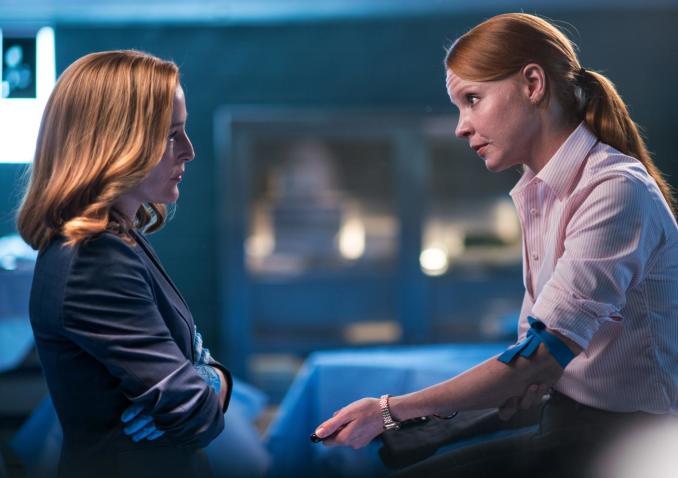
The Truth: The crazy theory of the week is that the American population has been infected with alien DNA that was administered during the smallpox vaccinations (this is all sounding very familiar) and then passed down hereditarily. This is being carried out on a scale which we never dreamed and scope that will quickly become global. A variety of contagions, like a fast-moving AIDS with the HIV (there’s words that will get people emoting), our immune systems decimated. The people we must depend on most will be hit first; the police, health care workers, etc. Soldiers being deployed to Iraq are given a dose of anthrax to help their immune systems fight biological warfare. We’re infecting them rather than protecting them. The truth is the virus was already there and it is alien DNA that can save everybody. Scully is the answer, or at least the DNA that lies within her. It needs to be extracted and injected into everybody. The alien DNA is the only thing that can kill this virus that is murdering the population. Well, that’s irony on a level that is so funny its almost the ultimate X-Files joke. The one thing that has been presented as the ultimate horror (humans infected with alien DNA) since season two is now the one thing that can save us.
Moment to Watch Out For: I really like the fight in Mulder’s apartment that for once really feels like a fight to the death. Kill or be killed. Carter is deploying every cinematic tactic possible to make this as energetic as possible (at times it almost feels like a scene out of the Matrix) but it’s a stunning scene of violence in an otherwise static and talky episode. Anyone who thought Duchovny might be past it might be shocked by his dynamism here.
Result: There’s a lot that My Struggle II gets wrong, but there’s an awful lot it gets right too and whilst it isn’t the season finale perhaps it should have been I think it has become a little too easy to bash Chris Carter and look away from his strengths. There’s a passion and muscle to this episode that has been missing from the revival, there are some dramatic and violent moments, enthusiastically directed, and a feeling that the shit has genuinely hit the fan in a very exposed way. It used to annoy me that the original run used to hide away so much of the epic storytelling from the general public but this alien invasion is shoved right down our throats in a very public, and thus quite affecting, way. There’s a feeling of everything coming to a head in this episode, which I don’t think the season deserves given that it is so short. This has the similar sort of feel as Existence in season eight, with all of the established characters (and even a few new ones introduced this year) coming together to fight the cause. But given this season is only six episodes long and those characters have had relatively little exposure, it falls a little flat as an explosive climax. It feels like putting your toys away just as you have started playing with them. Carter’s paranoia seems to have hit an all time high and he’s fizzing with crazy theories, turning practically every medical treatment into biological terrorism. It’s a little hysterical, but the show runs with it with its usual deadly serious tone and so it manages to half convince you purely because of how the information is delivered. The return of Monica Reyes should have been a celebration but instead it turns out to be a falsification of everything her character used to be about. Despite this, I really like the last ten minutes where the show finally pushes the world over into madness and it feels as though there is no going back. The scale of the mass exodus feels very real and the story pauses on a dramatically sound moment. If the series had ended here it would have been abominable to leave the fate of its best character so ambiguous but since we already knew it would back for another season it’s a breath-taking moment of high drama to climax the story on. My Struggle II is probably the best of Carter’s four mythology episodes in the revival, and that’s not really saying much given I can only award it a: 7/10


